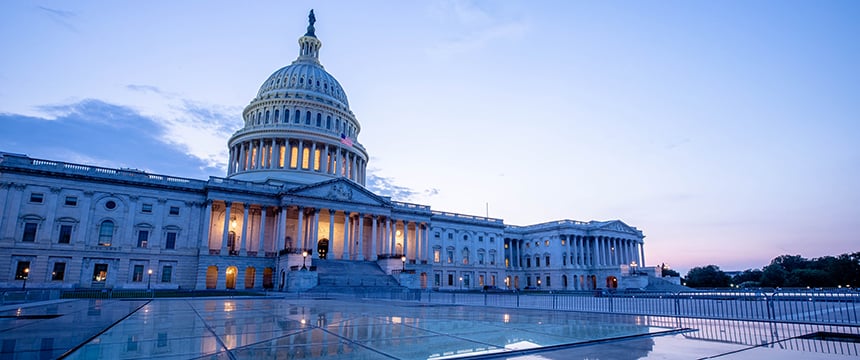
On May 12, 2020, the Democratic Speaker of the House of Representatives, Nancy Pelosi, released her proposal for “phase four” of federal legislation to provide relief regarding the coronavirus pandemic. This legislation, the Health and Economic Recovery Omnibus Emergency Solutions Act, or “HEROES” Act, totals $3 trillion and is expected to pass the House of Representatives on Friday, May 15, 2020. Republican Senate Majority Leader Mitch McConnell has called the bill “aspirational” and said several times he does not plan to act immediately on another round of stimulus legislation. However, he and Senate Republicans have started developing their own major package of COVID-related liability reforms to foster economic recovery. The final bill that is passed into law will be a result of negotiations between the two sides, and it will likely look much different than this iteration of the HEROES Act.
Additional information, updates, and analysis regarding the HEROES Act, and all relevant Congressional relief efforts, will be posted on Foley’s Coronavirus Resource Center. Please check back frequently for updates. Foley is available to assist in interpretation of the HEROES Act for your business and can help you find ways to claim and/or use available funding for your company.
Top 10 Takeaways of the HEROES Act:
- It is a $3 trillion piece of legislation that would have a wide-ranging impact on the country.
- Senate Republicans have indicated that they do not plan to act on any relief bill at this time. Any future relief bill that is passed into law would likely look much different than this. Two major sticking points are the Democrats’ priority of providing money for states, and Republicans’ priority of limiting the liability of businesses that reopen.
- The bill provides roughly $1 trillion in funds for state and local governments, including $500 billion directly to states and $375 billion to local governments, among other allocations of grant money.
- It appropriates an additional $100 billion into the provider relief fund to support hospitals and other health care providers.
- The bill strengthens the Payroll Protection Program and enhances the Employee Retention Tax Credit to encourage employers to maintain their workforce.
- It provides $100 billion for colleges and K-12 schools, and it extends student loan protections created in the CARES Act through September 2021. The bill provides up to $10,000 in debt relief for borrowers of federal and private student loans.
- The bill provides $75 billion in grants to state, local, Tribal, and territorial health departments to support a testing and contact tracing infrastructure.
- It establishes a $200 billion Heroes’ fund to ensure that essential workers who have continued working during the pandemic receive hazard pay.
- The bill requires workplaces to develop and implement infection control plans.
- It provides $175 billion for renters and homeowners in need to support rent, mortgage, utility payments, and other housing-related costs.
For more information about recommended steps, please contact your Foley relationship partner. For additional web-based resources available to assist you in monitoring the spread of the coronavirus on a global basis, you may wish to visit the CDC and the World Health Organization.
Foley has created a multi-disciplinary and multi-jurisdictional team, which has prepared a wealth of topical client resources and is prepared to help our clients meet the legal and business challenges that the coronavirus outbreak is creating for stakeholders across a range of industries. Click here for Foley’s Coronavirus Resource Center to stay apprised of relevant developments, insights and resources to support your business during this challenging time. To receive this content directly in your inbox, click here and submit the form.