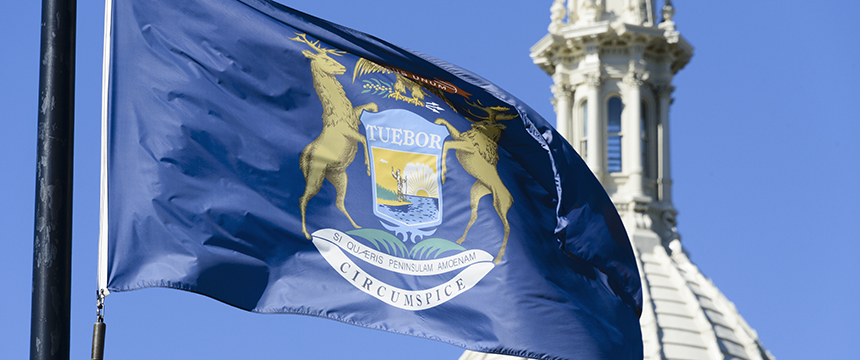
On Tuesday, April 13, 2021, Michigan Governor Gretchen Whitmer signed a certificate of need authorizing an extension of the Michigan Occupational Safety and Health Administration (“MIOSHA”) COVID-19 Emergency Rules (the “Emergency Rules”). The Emergency Rules were originally set to expire on April 14, however, the Administrative Procedures Act allows for one six-month extension. The Emergency Rules may now remain in place through October 14, 2021.
Under the MIOSHA Emergency Rules – issued to replace portions of executive orders deemed unconstitutional by the Michigan Supreme Court – employers are required to put in place a COVID-19 Preparedness and Response Plan. Critically, as part of the response plan, employers must adopt a policy prohibiting in-person work for employees to the extent that their work activities can feasibly be completed remotely. The Emergency Rules also dictate that employers must conduct exposure determinations and health surveillance for all employees, provide personal protective equipment for use on the job, and provide training on infection control. Employer resources for implementing the Emergency Rules’ protocols – including a sample COVID-19 Preparedness and Response Plan – may be found here.
Business leaders have remained vocal opponents of the remote work protocol portions of the Emergency Rules, and groups like Reopen Michigan Safely have lobbied extensively for in-person work to resume. Last month, Governor Whitmer responded by announcing the creation of a Michigan Department of Labor and Economic Opportunity working group. The group is tasked with advising the administration on how workers can safely return to offices. A day prior to the renewal of the Emergency Rules, the Governor also stressed that she did not believe residents would remain working from home for another six months. She also clarified that the Emergency Rules could be rescinded at any time if COVID-19 infection statistics permit.
However, calls for loosening restrictions have been tempered in recent days by a severe new surge in cases. The surge, which health experts are linking to the spread of variants of the virus and relaxed social-distancing restrictions, has caused Michigan to lead the nation with higher case rates than any other state. On April 5th, the Michigan Department of Health and Human Services (MDHHS) issued new guidance that reinstates a 14-day quarantine standard for those who have had “close contact” with someone who has had COVID-19 to address the rapid rise in case numbers. On April 12, the Director of the U.S. Centers for Disease Control and Prevention stated that Michigan should “close things down” to help address the outbreak, and Governor Whitmer similarly called for (on a voluntary basis) high schools to offer remote education for two weeks after spring break, youth sports to pause all activities for two weeks and people to avoid eating indoors at restaurants for the same amount of time. Despite these calls to limit activities, many schools and businesses have opted to remain open.
코로나19는 경제 전 분야의 기업들에 지속적인 영향을 미치고 있습니다. 폴리는 고객사가 사업 이익, 운영 및 목표에 미치는 단기적·장기적 영향을 효과적으로 대응할 수 있도록 지원합니다. 폴리는 다양한 산업 및 분야에 걸친 통찰력과 전략을 제공하여, 기업들이 코로나바이러스의 영향을 다루면서 사업을 수행하는 과정에서 직면하는 광범위한 법적·사업적 과제에 대한 시기적절한 관점을 제시합니다. 오늘의 도전과 내일의 기회를 다루는 주요 간행물을 통해 최신 동향을 파악하고 선제적으로 대응하려면여기를 클릭하십시오. 해당 콘텐츠를 이메일로 직접 수신하려면여기를 클릭하여양식을 제출하십시오.