Telehealth is Here to Stay: New 50 State Survey of Commercial Insurance Laws Reveals Progress

December 2, 2019
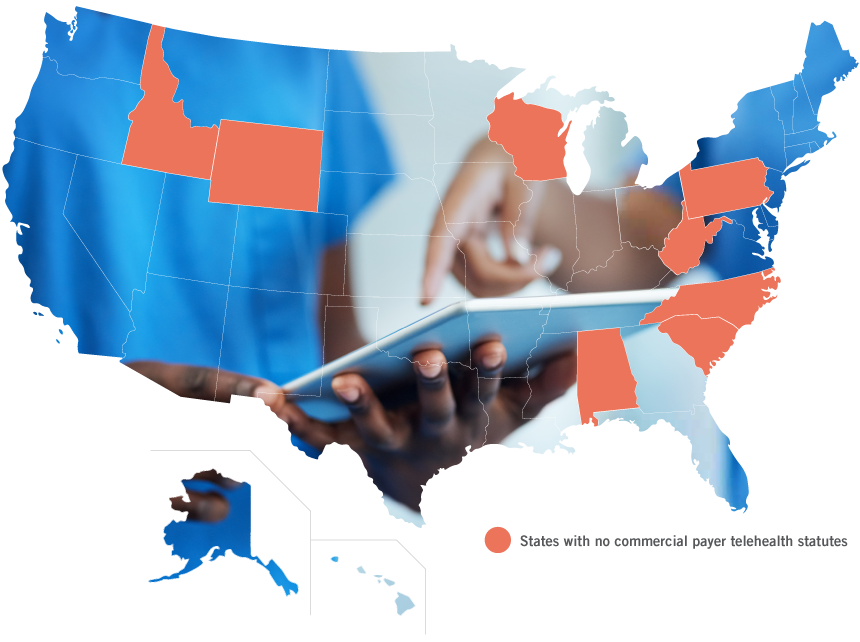
Two years after Foley’s 2017 Telemedicine and Digital Health Survey uncovered a demand for telemedicine and digital health services, as well as coverage and reimbursement to match the growing demand, Foley explores how each state has responded in its 2019 50-State Telehealth Survey plus District of Columbia (DC) of Commercial Payer Statutes.
The survey found that as of October 2019, 42 states maintain some sort of telehealth commercial payer law, however several of these state laws do not actually require coverage or payment parity.
Foley’s report breaks down variances in telehealth commercial statues state-by-state, including:
- States that have commercial payer statutes in place
- States that have coverage parity or limitations
- States that have payment parity
- States that impose originating site limits
- States that have patient cost shifting protection
- State laws that address telehealth narrow or exclusive networking
- States that require coverage of reimbursement of remote patient monitoring
- States that require coverage of store & forward/asynchronous telemedicine
To read the full survey, download the 2019 report.

Author(s)
Related Insights
May 6, 2026
Manufacturing Industry Advisor
Hot Topics in Product Stewardship: Key Regulatory Developments to Watch
Key Takeaways State‑driven regulation continues to shape product stewardship requirements, with California setting standards that may…
May 6, 2026
PharmaPatents
Flexibility Versus Indefiniteness: What It’s All About
In Enviro Tech Chemical Servs., Inc. v. Safe Foods Corp., the Federal Circuit recognized the permissibility of using “about” to “avoid a strict numerical boundary” for a claimed parameter, but held the claims at issue invalid as indefinite under 35 U.S.C. § 112(b). The court’s analysis highlights that the flexibility of “about” comes with a risk of invalidity, especially when the scope of the claimed range cannot be ascertained from the specification and prosecution history with reasonable certainty.
May 6, 2026
Manufacturing Industry Advisor
AI Predictive Maintenance in the Manufacturing and Supply Chains: Contract Strategies to Reduce Downtime and Liability
Across the automotive supply chain, Tier 1 and Tier 2 suppliers are rapidly adopting AI-powered predictive maintenance platforms. These tools promise to revolutionize plant operations—monitoring welding robots, stamping presses, and CNC machines through real-time sensor data, then forecasting failures before they happen. The potential upside is enormous: reduced unplanned downtime, optimized maintenance schedules, and a genuine competitive edge in an industry where every minute of line stoppage costs money.