




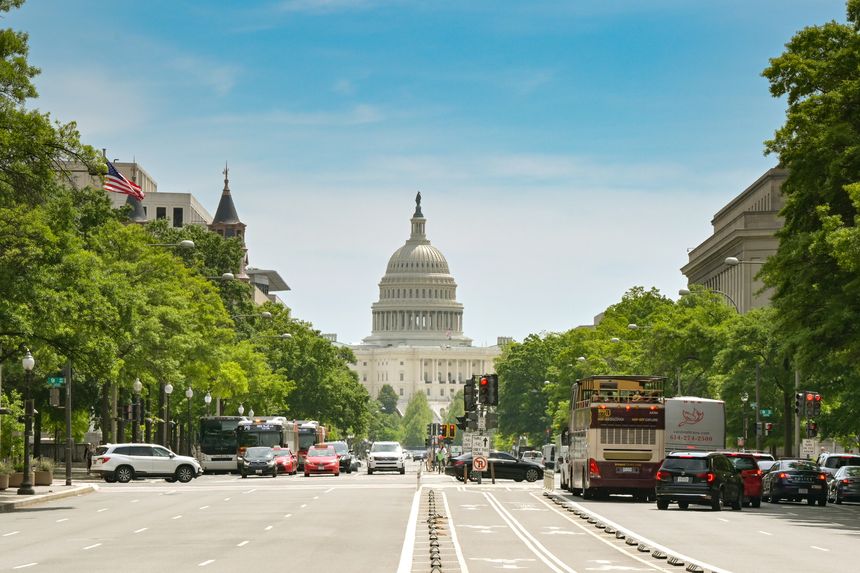
Government Shutdown
- Funding for much of the federal government lapsed on October 1 with the start of a new fiscal year. Government funding is supposed to be enacted through passage of 12 annual appropriations bills or a stopgap measure known as a continuing resolution (CR) that will keep funding levels as-is from the previous year for a temporary amount of time. No FY26 appropriations bills have yet been agreed to by both chambers.
- The House passed a “clean” (free of any policy changes) CR that would fund the government through November 21, 2025. That bill has failed three attempts to reach the 60-vote threshold needed for passage in the Senate, with a majority of Senate Democrats opposing.
- Senate Democrats offered their own CR that would have rolled back Medicaid cuts, permanently extended enhanced Affordable Care Act tax credits, and limited the capabilities of the Administration to rescind funding already appropriated by Congress. This bill also failed when brought to the floor for a vote.
- Republican leaders today made it clear that they have no plans to cede to the Democrats’ demands and said that Republicans will not engage in policy changes until Democrats first agree to vote to reopen the government.
- Unlike in past shutdowns, President Trump and Office of Management and Budget Director Russ Vought have threatened to enact mass layoffs of federal workers unless Democrats vote in favor of reopening the government. We are also seeing rollbacks of federal funding for projects primarily in blue states.
- Each federal agency will publish contingency guidance for government workers, detailing essential from nonessential work. As of today, even senior leadership in some federal agencies have been furloughed.
- Glimmer of hope? Three Senate Democrats have joined Republicans in voting to pass the CR and reopen the government – however, that’s still far from the number of Democrats needed. With that said, there have been bipartisan discussions among Senate R’s and D’s on a path forward for the ACA subsidies, leading to chatter that the shutdown may not last as long as the roughly 40-day shutdown in 2018. More to come.
The House and Senate are both in session next week, despite the government being shutdown.
Please reach out to the authors or your Foley relationship partner if you are facing any issues, or if you have any questions, with the ongoing changes by the Trump administration.
Disclaimer
This blog is made available by Foley & Lardner LLP (“Foley” or “the Firm”) for informational purposes only. It is not meant to convey the Firm’s legal position on behalf of any client, nor is it intended to convey specific legal advice. Any opinions expressed in this article do not necessarily reflect the views of Foley & Lardner LLP, its partners, or its clients. Accordingly, do not act upon this information without seeking counsel from a licensed attorney. This blog is not intended to create, and receipt of it does not constitute, an attorney-client relationship. Communicating with Foley through this website by email, blog post, or otherwise, does not create an attorney-client relationship for any legal matter. Therefore, any communication or material you transmit to Foley through this blog, whether by email, blog post or any other manner, will not be treated as confidential or proprietary. The information on this blog is published “AS IS” and is not guaranteed to be complete, accurate, and or up-to-date. Foley makes no representations or warranties of any kind, express or implied, as to the operation or content of the site. Foley expressly disclaims all other guarantees, warranties, conditions and representations of any kind, either express or implied, whether arising under any statute, law, commercial use or otherwise, including implied warranties of merchantability, fitness for a particular purpose, title and non-infringement. In no event shall Foley or any of its partners, officers, employees, agents or affiliates be liable, directly or indirectly, under any theory of law (contract, tort, negligence or otherwise), to you or anyone else, for any claims, losses or damages, direct, indirect special, incidental, punitive or consequential, resulting from or occasioned by the creation, use of or reliance on this site (including information and other content) or any third party websites or the information, resources or material accessed through any such websites. In some jurisdictions, the contents of this blog may be considered Attorney Advertising. If applicable, please note that prior results do not guarantee a similar outcome. Photographs are for dramatization purposes only and may include models. Likenesses do not necessarily imply current client, partnership or employee status.
Author(s)


Related Insights
September 25, 2026
Health Care Law Today
Proposed Federal CPOM Legislation: What the Stop Corporate Takeovers of Physicians Act Would Mean for Private Equity and MSO-Based Transactions
On September 16, 2026, Senators Elizabeth Warren (D-Mass.), Ron Wyden (D-Ore.), and Jeff Merkley (D-Ore.), along with Representatives Val Hoyle (D-Ore.), Alexandria Ocasio-Cortez (D-N.Y.), and Suhas Subramanyam (D-Va.), introduced the Stop Corporate Takeovers of Physicians Act of 2026.
August 17, 2026
Health Care Law Today
FQHCs: The Expanding Landscape of Medicare Billing Outside of PPS for Care Management Services
Federally Qualified Health Centers (FQHCs) are primarily reimbursed by Medicare through the Prospective Payment System (PPS), which pays a per-visit rate to cover a typical bundle of medically necessary services provided during a patient encounter. Increasingly, however, FQHCs have opportunities to bill certain care management services to Medicare outside the PPS bundle. The steady expansion of these services over the last decade is one of the most significant changes to Medicare FQHC reimbursement since the Affordable Care Act (ACA).
July 21, 2026
Health Care Law Today
Off-Campus Outpatient Departments: CMS’ Proposed Rule for the New Mandatory Attestation Process
The Centers for Medicare & Medicaid (CMS) issued proposed regulations implementing Section 6225 of the Consolidated Appropriations Act, 2026 (CAA), codified at 42 U.S.C. § 1395l(t)(23), as part of the proposed Calendar Year (CY) 2027 Hospital Outpatient Prospective Payment (OPPS) rule.