USPTO Invites Patent Owner Input To Stem Tide Of Reexamination Proceedings

After issuing an April Fool’s Day press release announcing an imagined “AI-assisted evaluator for patent eligibility determinations,” the USPTO issued another press release on April 1, 2026, that stakeholders need to take seriously. The real notice relates to ex parte reexamination proceedings, and announced a new process permitting patent owners to weigh in before the USPTO decides whether to proceed with reexamination.
According to the USPTO Notice, the Director is waiving existing rules that do not provide for early patent owner input, due to the “extraordinary situation” of “the recent increased volume of ex parte reexamination requests.” Having expanded the use of discretionary denials to limit Inter Partes Review (IPR) proceedings, it seems the USPTO now seeks to stem the tide of ex parte reexamination proceedings.
The Current Reexamination SNQ Paradigm
Under 35 U.S.C. § 302, “Any person at any time may file a request for reexamination … of any claim of a patent on the basis of any prior art ….” Under 35 U.S.C. § 303, “[w]ithin three months following the filing of a request for reexamination … the Director will determine whether a substantial new question of patentability affecting any claim of the patent concerned is raised by the request ….” Under 35 U.S.C. § 304, “[i]f … the Director finds that a substantial new question of patentability … is raised, the determination will include an order for reexamination of the patent for resolution of the question.”
Thus, unlike the IPR statute that gives the Director discretion whether to institute an IPR proceeding, the reexamination statute seems to require the Director to order reexamination if it is found that a substantial new question of patentability (“SNQ”) has been raised. But see 35 U.S.C.§ 325(d) (referenced below).
The statutory reexamination scheme does not expressly provide for patent owner input until after an SNQ determination has been made. Under 35 U.S.C. § 304, “The patent owner will be given a reasonable period … within which he may file a statement on such [SNQ], including any amendment … for consideration in the reexamination.” Indeed, under current USPTO guidance “[t]he patent owner has no right to file a statement subsequent to the filing of [a request for reexamination] prior to the order for reexamination.” See MPEP § 2249.
The New Process for Input from Both Sides
The Notice explains that the new process will enable the USPTO to make SNQ determinations with “the benefit of relevant information from patent owner[s].” The patent owner pre-order paper must be filed “no later than the date that is 30 days from the date of service of the request on the patent owner” and “be limited to thirty (30) pages or fewer.” Regarding the content:
The [patent owner pre-order] paper must be limited to arguments or facts to support patent owner’s position that, despite the argued teaching(s) in the request, the Office should maintain the decision of patentability made during examination … after considering the alleged new teaching(s) in the request for reexamination.
On the other hand, the pre-order paper “should not address why the USPTO should exercise discretion under 35 U.S.C. § 325(d),” which is considered after an SNQ determination has been made. Further, arguments regarding whether an alleged teaching is “new” “should not be included in a patent owner pre-order paper,” because those arguments can be presented in a patent owner’s statement under 37 CFR §1.530 or in a patent owner’s response to an Office action” during the reexamination proceeding.
Under the new process, the reexamination requester will not generally be permitted to respond to the patent owner’s pre-order paper, but may petition to do so under exceptional circumstances, “such as to address alleged misrepresentations of fact or law or other improper arguments that materially impede the determination of a substantial new question.”
According to the Notice, “[w]hen considering whether to order reexamination, the Office will review the request and the contents of any patent owner pre-order paper and any third party requester responsive paper …. [and] then determine whether the request establishes a substantial new question of patentability.”
Will the New Process Stem the Tide of Reexamination Requests?
The impact of the lower IPR institution rate on reexamination requests is evident in USPTO reexamination statistics, which show requests have more than doubled in recent months.
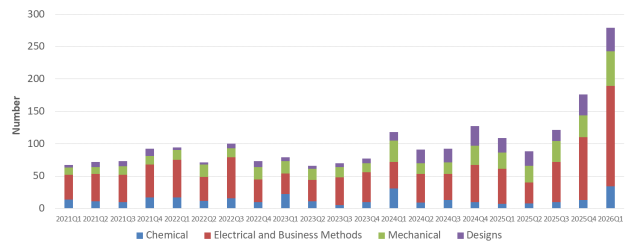
While reduced USPTO staffing levels may make it challenging to review these requests in a timely manner, it is not clear that permitting early patent owner input will discourage requests for reexamination, unless it leads to a significant drop in SNQ findings. Indeed, stakeholders on the requester side likely will view the new process as an attempt to make it easier for the USPTO to deny reexamination requests, further limiting opportunities to have the USPTO review its own work and revoke patents that never should have been granted.
Can the USPTO Do This?
The Patlex Corp. v. Mossinghoff case cited in the Notice (758 F.2d 594 (Fed. Cir. 1985)) upheld the USPTO’s current rules that restrict patent owner input prior to the SNQ determination. In that case, the USPTO justified the restrictions in the interests of efficiency, stating that the USPTO “can not accommodate a ‘flurry of paper’ at this [SNQ] stage.”
Although the court found the rules were “within tolerable limits of … the reexamination statute” and did “not violate the due process clause,” it seems likely that the Federal Circuit would uphold new rules implementing a new process that gives patent owners an early opportunity to be heard. Indeed, the USPTO’s justification for the new process implies that increased efficiencies being realized in the Central Reexamination Unit mean that patent owner pre-order papers “can be accommodated” and “should enable the Office to be better able to weed out those requests that do not raise a substantial question of patentability, prior to instituting a full-blown proceeding.”
The Official Gazette Notice set to be published April 26, 2026, includes other significant changes to reexamination practice and sets a public comment period expiring May 30, 2026.