The Data-Driven Prosecutor: How DOJ’s Analytics Revolution Is Reshaping Fraud Enforcement

On May 18, 2026, a jury in the Central District of California convicted Dr. Violetta Mailyan of orchestrating a $45 million scheme to defraud Medicare through fraudulent Botox injection claims. While the fraud itself was bold enough, what makes this case a bellwether is how the government caught her.
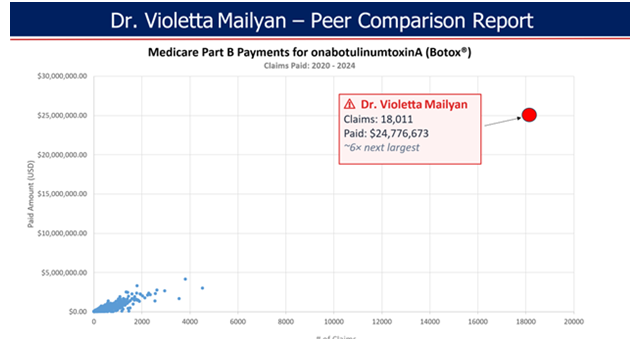
The Department of Justice’s (DOJ) Health Care Fraud Section’s Data Analytics Team flagged Mailyan after its analysis showed she collected more Medicare payments for Botox injections than any other doctor in the country. At trial, prosecutors drove the point home with a peer comparison exhibit — a graph showing Mailyan as an extreme statistical outlier who raked in more than $24 million over four years, which was six times more than the next highest group of providers. The visual is striking, intuitive, and devastating. It reduced a complex fraud scheme to a single, irrefutable data point: this doctor is not like others:
The Mailyan case is not an isolated success story. It is the most recent illustration of a fundamental shift in how the federal government detects and prosecutes health care fraud — a shift from reactive investigation to proactive, data-driven identification of fraudulent actors.
The Rise of the Data Analytics Team
The DOJ’s Health Care Fraud Unit’s Data Analytics Team was established to enhance the Unit’s ability to detect, investigate, and prosecute complex health care fraud schemes. Since its founding, the team has grown in both capacity and ambition. According to the DOJ’s 2025 Year in Review, the Data Analytics Team completed 2,085 data requests and 164 proactive data referrals in 2025 alone — referrals that aided charging decisions, resolution of significant matters, and asset seizures.[1]
The term “proactive referral” is the key phrase. Traditional health care fraud enforcement has long followed a “pay and chase” model — the government pays claims, receives a tip or complaint, investigates after the fact, and then attempts to recover funds that have often already been dissipated. Proactive data referrals work to invert this paradigm. The Data Analytics Team identifies statistical anomalies, billing outliers, and suspicious patterns in claims data before a complaint is filed and, in some cases, before the money even goes out the door.
The Mailyan case is a textbook example. Nobody filed a whistleblower complaint. No disgruntled employee called a tip line. The data itself raised the alarm.
What This Means for Health Care Providers
The practical implications for health care providers are significant. The DOJ is no longer primarily dependent on whistleblowers, patient complaints, or traditional investigative leads to initiate cases. The government is actively mining Medicare and Medicaid claims data to identify outliers — and it is doing so continuously.
The Mailyan trial exhibit, a peer comparison graph showing the defendant multiple standard deviations from her peers, is a preview of what juries will see in future cases. It is simple, visual, and powerful. A provider who is a dramatic statistical outlier will face the immediate inference that something is wrong, and the burden of explaining away that data will fall squarely on the defense.
For compliance purposes, providers should assume that their billing data is being analyzed and compared against their peers at all times. Internal compliance programs should incorporate the same types of analytics the government is using — peer comparisons, outlier detection, and trend analysis — to identify and remediate potential issues before the government comes calling. As the DOJ’s enforcement record makes clear, it is far better to be the one who finds the anomaly first.
Conclusion
The conviction of Dr. Mailyan is a milestone not because of the fraud itself but because of what it represents about the future of health care fraud enforcement. The government found this case not through a tip, not through a whistleblower, but through data. And it proved the case at trial not primarily through cooperators or paper trails, but through a graph showing that the defendant’s billing was so far from the norm as to be inexplicable by any legitimate practice.
As the DOJ continues to invest in its Data Analytics Team and AI-powered detection capabilities, providers should expect that the era of “pay and chase” is giving way to an era of “detect and prevent”. The peer comparison chart in the Mailyan trial may prove to be one of the most consequential trial exhibits in recent health care fraud enforcement — not for what it showed about one doctor but for what it signals about how the government intends to find and prosecute the next one.