Increased Flexibility for Graphical User Interface Design Patent Applicants

On March 12, 2026, the U.S. Patent and Trademark Office (“USPTO”) released new guidance[1] (the “Guidance”) that updates prior USPTO practice guidelines for the examination of design patent applications for computer-generated interfaces, commonly known as graphical user interfaces (“GUIs”) and icons.
With the evolution of computer technology, such as the increased usage of artificial intelligence, the USPTO recognizes that the field of GUI designs is also evolving at a rapid pace. Appreciating this evolution is spurring the USPTO and others[2] to enable designers to effectively and efficiently protect their computer interface designs.
We expect the rise of GUI, icon, and other virtual interface designs to increase given this Guidance, and the number of rejections during examination to decrease given the more flexible standards announced in this Guidance.
A couple of notes regarding the Guidance are provided below, starting with some key takeaways.
- Guidance Highlights Additional Design Patent Subject Matter: The Guidance highlights that projections, holograms, and virtual and augmented reality icons or interfaces are eligible for design patent protection so long as the designs are disclosed and claimed correctly.
- Guidance Eliminates the Requirement to Depict Display Screen/Panel: Applicants no longer need to depict a display screen in applications related to computer-generated images, which was formerly a requirement of MPEP 1504.01(a), as long as both the title and the claim properly identify the article of manufacture (e.g., a computer).
The USPTO warns that design patents cannot claim transient, disembodied, or three-dimensional computer-generated images alone; they must still claim the design of an article of manufacture.
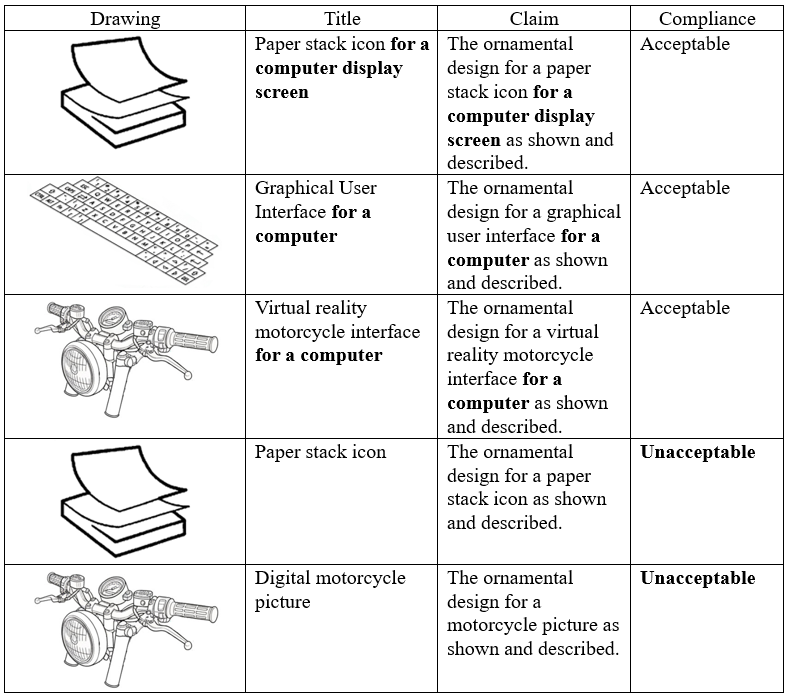
With this Guidance, there are now two ways to comply with this requirement: (i) show the display screen or portion thereof in broken lines (traditional method) or (ii) the title and the claim must properly identify the article of manufacture, even if there is no display panel depicted in the drawings.
With respect to option (ii), Applicants can now omit showing the display screen in dashed lines so long as the title and claim identify the article of manufacture (e.g., for a computer, computer system, computer display panel, etc.).The guidance instructs applicants to use language with the word “for,” such as: “icon for display panel,” “projected interface for computer,” or “interface for computer system.”
Based on the foregoing, examples of acceptable and unacceptable drawings, titles, and claims relative to the Guidance are provided below.
While we expect to see an increase in computer interface applications, it is important to note that this help is specific to the U.S. Caution should be employed when pursuing virtual interface designs abroad.
[1] See https://federalregister.gov/d/2026-04987
[2] India has recently proposed several changes to their Designs Act, including proposing amendments to expressly provide for design patent protection for GUIs, icons, and other virtual designs (e.g., AR/VR interfaces). See https://www.dpiit.gov.in/static/uploads/2026/01/791a71ebde47d93b67560f7394be2fec.pdf