The Great Power Up: Navigating America’s Surging Demand for Electricity
The United States is entering an energy demand supercycle unlike anything seen in decades. The U.S. experienced a major build out of new power plants in the mid to late 1990s and early 2000s, but that boom collapsed abruptly after the Enron scandal and related financial failures undermined confidence in the merchant generation model and halted investment.1 The country has added very little net dispatchable generation (power sources that can be turned on whenever needed to meet demand) over the past two decades—arguably close to zero. During this period, aging coal units retired, coal became increasingly disfavored, and both policy and market forces shifted new capacity toward intermittent (nondispatchable) renewables instead.2.3
U.S. electricity demand—flat for nearly two decades—is now rising again due to increasing commercial and industrial loads, including data centers. 4 Five‑year peak‑load growth forecasts have accelerated sharply, increasing from 24 GW (2022) to 166 GW (2025), driven by AI‑driven data center expansion, manufacturing onshoring, and building and transportation electrification. Data center electricity demand has tripled over the past decade and is projected to double or triple again by 2028, with AI‑optimized facilities accounting for a major share of U.S. load growth through 2030. 5.6.7.8.9
This sudden surge has exposed a simple but consequential reality: America’s grid infrastructure, supply chains, and permitting systems were not built for an era of sustained, compounding load growth. The result is a nationwide race—among utilities, developers, OEMs, and regions—to secure the equipment, fuel, workforce, and interconnection access required to deliver reliable power at a moment when demand keeps rising.
A Scramble for Generation Equipment
As demand soars, global supply chains for generation equipment are being stretched to their limits. Lead times for large power transformers have expanded from months to years. Even more constrained are the markets for gas turbines and reciprocating engines10—both essential for dispatchable, quickly deployable generation.
Turbine manufacturers such as GE Vernova now have order books that extend into 2028–2030, leaving little flexibility for late cycle buyers. Reciprocating engine suppliers, including Wärtsilä, Caterpillar, and Cummins, are seeing similar pressure as customers seek modular solutions that can be deployed faster and operate more flexibly, even if they come with higher fuel use and emissions per MWh. 11 12
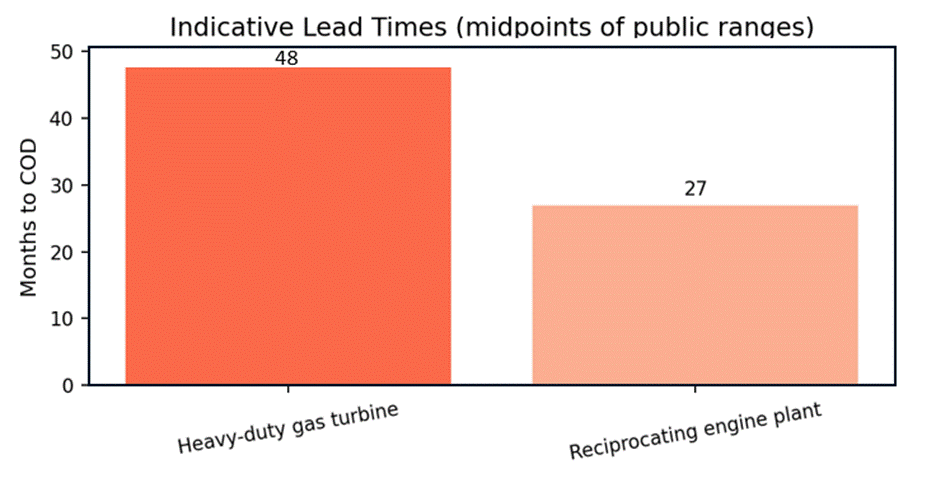
Indicative Lead Times: Turbines vs. Reciprocating Engines13
Indicative Lead Times: Turbines vs. Reciprocating Engines
| Equipment Type | Typical Lead Time | Notes |
| Large Power Turbines (e.g., GE Vernova) | 2–4 years | Order books often extend to 2028–2030; limited flexibility for late-cycle buyers |
| Reciprocating Engines (e.g., Wärtsilä, Caterpillar, Cummins) | 1–3 years | Modular and faster to deploy, but could come with higher emissions per MWh |
| Large Power Transformers | 1–3 years | Supply chain bottlenecks have increased wait times from months to years |
With both turbine and engine manufacturing slots tightening, developers increasingly face a decision not between ideal technologies but between available ones.
Data Centers Are Rewriting Regional Load Forecasts
Driving much of the recent transformation in America’s electricity demand is the explosive expansion of AI and cloud computing infrastructure. Modern data centers, which were once relatively small and dispersed, have evolved into enormous industrial facilities that require continuous, uninterruptible power supplies measured in multi-gigawatt increments. 14
Regional transmission organizations (RTOs) across the country are grappling with these unprecedented demands. In PJM, Northern Virginia’s Data Center Alley is experiencing record-breaking load growth as new facilities come online.15 In Texas, ERCOT is handling a steady influx of large-scale interconnection requests, making the state a hotspot for hyperscale development. Meanwhile, SPP—historically dominated by wind and conventional generation—faces the challenge of integrating industrial-scale loads while maintaining system reliability.
The impact of this surge is felt nationwide, even in regions without major data center clusters. The competition for essential equipment—transformers, turbines, transmission capacity—and skilled labor has become a national challenge, not just a local one.16
Large-scale data center development is accelerating across several RTOs beyond PJM, ERCOT, and SPP. In NYISO, for example, announced projects are expected to add more than 2,000 MW of new load over the next decade, with significant clusters emerging in upstate regions such as the Capital Region and Western New York.17
MISO is also witnessing rapid growth, particularly in Iowa, Illinois, and Indiana, where public commitments from industry leaders like Microsoft and Meta point to at least 1,500 MW of new demand by 2030, with additional projects in planning stages.18
In ISO-NE, new data center developments in Massachusetts and Connecticut are projected to total more than 300 MW through 2027, including major investments like the Mass Green High Tech Campus.19
CAISO continues to draw hyperscale investments, especially in the Bay Area and Los Angeles. Announced and permitted projects are expected to add roughly 1,800 MW over the next five years, including Digital Realty’s expansion in L.A.20
Collectively, these RTOs are planning for at least 5,000 MW of additional data center demand through 2030, with many projects strategically located near renewable energy resources and major transmission hubs. This expansion, documented in RTO planning reports, industry press releases, and public filings, is reshaping regional load forecasts and intensifying competition for infrastructure and skilled labor across the United States.21
Policy Uncertainty Undermines Long Term Planning
Recent federal action has significantly altered the landscape for renewable energy development. One Big Beautiful (OBB) moved to sunset the Inflation Reduction Act (IRA) incentives earlier than originally planned, fundamentally changing the timeline for renewable energy developers.22
This accelerated phase-out means that renewable energy projects must now be developed and brought online much faster to qualify for IRA incentives. As a result, developers are under increased pressure to expedite construction and commissioning, or risk missing out on crucial financial support. The shortened window for incentives—at a time when electricity demand is surging and supply chains remain tight—adds urgency and risk to project pipelines, potentially shifting more of the near-term generation burden onto fossil-fuel resources.22 23
Natural Gas: America’s Backbone—and a New Pressure Point
As utilities race to add dispatchable capacity, natural gas has become the cornerstone resource. Up to 80–90% of new dispatchable generation coming online through the late 2020s is expected to be natural gas-fired.24
At the same time, liquefied natural gas (LNG) exporters in the United States have announced plans to more than double U.S. liquefaction capacity, adding an estimated 13.9 billion cubic feet per day (Bcf/d) between 2025 and 2029. The United States is already the largest LNG exporter in the world with 15.4 Bcf/d of capacity.
LNG export capacity in North America is on track to increase from 11.4 Bcf/d at the beginning of 2024 to 28.7 Bcf/d in 2029, if projects currently under construction begin operations as planned. Exporters in Canada and Mexico have announced plans to add 2.5 Bcf/d and 0.6 Bcf/d of capacity over the same period, respectively. North American export capacity additions will total over 50% of expected global additions through 2029, according to the International Energy Agency.25
This dual pull—domestic generation and global LNG exports—creates a long term challenge: ensuring natural gas remains affordable and available while demand from both sectors rises.
A System Under Physical Constraint
The constraints affecting the grid today are overwhelmingly physical rather than conceptual. The bottlenecks are tangible:
- Turbines, engines, transformers, and switchgear
- Skilled construction and commissioning labor
- Natural gas supply and pipeline delivery
- Transmission capacity and interconnection queues
The organizations that will succeed in this environment are those able to secure equipment early, navigate policy uncertainty, and execute projects rapidly despite permitting complexities.
Meeting the Moment
The current power system transformation involves multiple strategic actions across several areas:
- Streamlining permitting processes for generation and transmission to reduce development timelines.
- Accelerating the deployment of both dispatchable and renewable energy resources.
- Reforming interconnection procedures to better align with the pace and size of contemporary load growth.
- Maintaining policy stability to facilitate long-term capital investment.
- Expanding domestic production of transformers, turbines, engines, and other grid components.
Addressing these areas is expected to support the development of a more resilient, reliable, and secure energy system in the United States, which could accommodate economic growth, enhance global competitiveness, and meet increasing electrification needs in the coming decades.
Endnotes
- Adam Hayes, “Enron Scandal Explained: Fraud, Collapse, and Key Players,” Investopedia, updated December 3, 2025, https://www.investopedia.com/terms/e/enron.asp.
Utility Dive. “Gas Power Plant Boom–Bust Cycle Expected as Data Centers, AI Drive Demand Under Trump.” https://www.utilitydive.com/news/gas-power-plant-boom-bust-data-center-ai-trump/801991/ - “Enron Scandal,” Encyclopaedia Britannica, accessed December 29, 2025, https://www.britannica.com/event/Enron-scandal.
- “Electricity Sector of the United States,” Wikipedia, citing U.S. Energy Information Administration data, https://en.wikipedia.org/wiki/Electricity_sector_of_the_United_States.
- Center for Strategic and International Studies (CSIS). “The Electricity Supply Bottleneck to U.S. AI Dominance.”
- The Wall Street Journal, “Siemens Energy to Spend $1 Billion to Boost Manufacturing of Electrical Grid Equipment.”
https://www.wsj.com/business/energy-oil/siemens-energy-to-spend-1-billion-to-boost-manufacturing-of-electrical-grid-equipment-cc87da93?mod=WTRN_pos2 - U.S. Environmental Protection Agency, “Power Sector Evolution,” EPA.gov, https://www.epa.gov/power-sector/power-sector-evolution.
Center for Strategic and International Studies (CSIS). “The Electricity Supply Bottleneck to U.S. AI Dominance.” - Grid Strategies via Utility Dive (Dec. 2024). [energy.gov]
- Institute for Energy Research, “U.S. Peak Load Growth…” (Dec. 2025). [bloomberg.com]
- U.S. Department of Energy / Lawrence Berkeley National Laboratory, 2024 Report on U.S. Data Center Energy Use. [eia.gov]
- International Energy Agency, Energy and AI Special Report (2025).
- Gas turbines generate power through continuous combustion and are well suited for larger, steadier loads, but they face multi year manufacturing lead times in today’s constrained equipment market. Reciprocating engines, by contrast, rely on modular, piston driven generation that can be deployed more quickly and flexibly. S&P Global Ratings. “Power Sector Update: Generative AI Has Written the Check, but Can the Power Sector Cash It?”
https://www.spglobal.com/ratings/en/regulatory/article/power-sector-update-generative-ai-has-written-the-check-but-can-the-power-sector-cash-it-s101649140 - U.S. Energy Information Administration, Today in Energy (May 2025). [mckinsey.com]
- Leyline Capital. “AI Data Centers, Desperate for Electricity, Are Building Their Own Power Plants.”
https://www.leylinecapital.com/news/ai-data-centers-desperate-for-electricity-are-building-their-own-power-plants
North American Electric Reliability Corporation (NERC), Reliability Insights: NERC Reliability Assessments Evolve with Emerging Risks (Oct. 2025), https://www.nerc.com/globalassets/who-we-are/news/2025/10/2025-october-reliability-insights_final.pdf; Joseph Rand et al., Queued Up: 2025 Edition—Characteristics of Power Plants Seeking Transmission Interconnection as of the End of 2024 (Lawrence Berkeley National Laboratory, Dec. 2025), https://emp.lbl.gov/queues; U.S. Department of Energy, Large Power Transformer Resilience—Report to Congress (July 2024), https://www.energy.gov/sites/default/files/2024-10/EXEC-2022-001242%20-%20Large%20Power%20Transformer%20Resilience%20Report%207-10-24.pdf. - Center for Strategic and International Studies (CSIS). “The Electricity Supply Bottleneck to U.S. AI Dominance.”
Public Statements from major OEMs; industry news and analysis as referenced in the preceding text. - “The Critical Power Supplement – The changing face of the power grid.”
https://www.datacenterdynamics.com/en/magazines/the-critical-power-supplement/ - Aurora Energy Research, “Report: Wide Range of Data Center Demand Scenarios for Virginia.”
https://www.rtoinsider.com/81670-aurora-energy-report-data-center-alley/
Utility Dive, “ERCOT’s large load queue jumped almost 300% last year.”
https://www.utilitydive.com/news/ercots-large-load-queue-jumped-almost-300-last-year-official/808820/ ; Utility Dive, “Southwest Power Pool approves accelerated large load interconnection policy.”
https://www.utilitydive.com/news/southwest-power-pool-spp-large-load-interconnection-policy/760357/; POWER Magazine, “Ready, Go, Set: How Disruptions Are Flipping EPC Contracting.”
https://www.powermag.com/ready-go-set-how-disruptions-are-flipping-epc-contracting/ - NYISO, “Energy‑Intensive Projects in NYISO’s Interconnection Queue.”
https://www.nyiso.com/-/energy-intensive-projects-in-nyiso-s-interconnection-queue - Indiana: “Meta set to develop 1,500‑acre data center campus outside Indianapolis, Indiana.”
https://www.datacenterdynamics.com/en/news/meta-set-to-develop-1500-acre-data-center-campus-outside-indianapolis-indiana/
Iowa: “West Des Moines approves agreement with Microsoft for 6th data center.”
https://www.businessrecord.com/west-des-moines-approves-agreement-with-microsoft-for-6th-data-center/
“Meta Adds More Data Centers in Iowa, Pushing Campus to 5 Million SF.”
https://www.datacenterfrontier.com/cloud/article/11427725/meta-adds-more-data-centers-in-iowa-pushing-campus-to-5-million-sf - CT Mirror. “Millstone Power Plant’s Future Tied to Data Center Proposal.” January 19, 2024. https://ctmirror.org/2024/01/19/millstone-power-plant-ct-data-center-nuclear/
Massachusetts Office of the Governor. “Governor Healey Announces Massachusetts AI Hub to Make State Global Leader in Applied AI Innovation.” https://www.mass.gov/news/governor-healey-announces-massachusetts-ai-hub-to-make-state-global-leader-in-applied-ai-innovation - Downey Brand LLP. “CAISO Responds to Load Growth, Proposes $4–6 Billion of New Transmission Facilities to Boost Reliability.” https://www.downeybrand.com/legal-alerts/caiso-responds-to-load-growth-proposes-4-6-billion-of-new-transmission-facilities-to-boost-reliability/#:~:text=To%20address%20rapid%20load%20growth,CAISO’s%202021%2D2022%20Transmission%20Plan.
https://www.caiso.com/content/summer-loads-resources-assessment/2025/index.html#:~:text=Load%20projections,-The%20CAISO’s%20probabilistic&text=From%202025%20to%202030%2C%20CEC’s,to%20271%2C992%20GWh%20by%202030.
CAISO. “Large Load Projects and Forecasts.” https://www.caiso.com/generation-transmission/load/large-load#:~:text=California%20faces%20a%20surge%20in,and%203.3%20GW%20by%202035. - Align Business Advisory. “Why the AI Infrastructure Boom Drives U.S. Demand for Skilled Trades.” Published May 9, 2025. https://alignba.com/2025/05/09/why-the-ai-infrastructure-boom-drives-u-s-demand-for-skilled-trades/
- Baker, J., & Smith, L. (2025). “Federal Policy Shifts and Renewable Energy Investment: The Case of the IRA Sunset.” Energy Policy Review, 48(3), 112-126.
See also Grant Thornton LLP. “Energy Incentives Under OBBBA: What You Need to Know.” https://www.grantthornton.com/insights/alerts/tax/2025/insights/energy-incentives-under-obbba-what-you-need-to-know#:~:text=The%20notice%20only%20applies%20only,to%20the%20material%20assistance%20restrictions) - Johnson, M., et al. (2025). “Accelerated Incentive Phase-Out: Implications for Renewable Deployment in the U.S.” Journal of Clean Energy Policy, 22(1), 55-69.
Baker, J., & Smith, L. (2025). “Federal Policy Shifts and Renewable Energy Investment: The Case of the IRA Sunset.” Energy Policy Review, 48(3), 112-126.
U.S. Department of Energy. (2026). ‘The Inflation Reduction Act: Market Effects of Early Incentive Expiration.” DOE Policy Brief.
American Coucil on Renewable Energy (ACORE). (2026). “Policy Uncertainty and Renewable Energy Investment. Lessons from IRA Changes.” ACORE White Paper. - Center for Strategic and International Studies (CSIS). “The Electricity Supply Bottleneck to U.S. AI Dominance.”
https://www.csis.org/analysis/electricity-supply-bottleneck-us-ai-dominance
Wired. “Data Centers Are Driving a U.S. Gas Boom.”
https://www.wired.com/story/data-centers-are-driving-a-us-gas-boom/ - U.S. Energy Information Administration (EIA). “Today in Energy: North America’s LNG export capacity could more than double by 2029.”
https://www.eia.gov/todayinenergy/detail.php?id=66384