Sectors
A man with short brown hair and glasses, dressed in a dark suit, white shirt, and tie, poses against a plain gray background—reflecting the professional image often found in corporate law office settings.

Parker White

Associate

Parker White assists clients in matters regarding national security and international trade, reinsurance disputes, and federal civil rights violations. He has published several articles on international arbitration, U.S. sanctions, and international trade. He is a primary member of the Commercial Litigation Practice Group and a secondary member of the Government Enforcement Defense & Investigations Practice Group.

In his previous role, Parker served as a judicial clerk at the United States District Court for the Eastern District of Wisconsin, supervising 125+ civil cases on the general civil and habeas dockets, including cases involving employment discrimination, insurance, FLSA, ERISA, and civil rights. He drafted orders on motions including motions for summary judgment, motions to dismiss, and motions to remand. He has also worked for a federal judge in the Northern District of California, where he drafted orders in cases involving maritime law, securities law, and criminal law—including the Elizabeth Holmes criminal trial.

During his time at Harvard Law School, Parker received internships with the Office of the Legal Counselor at the U.S. State Department and an international law firm in The Hague. He was a summer associate at the Public International Law & Policy Group in Washington, D.C.

Parker also holds a master’s in Public Policy from Harvard Kennedy School, through which he worked for the Atlantic Council’s Digital Forensic Research Lab, reporting on disinformation in elections and armed conflicts, and researching United States and Russia relations for Evelyn Farkas. He was a Fulbright AmeriCorps volunteer in Alabama, his home state.

Awards and Recognition

  • Rhodes Scholarship Finalist
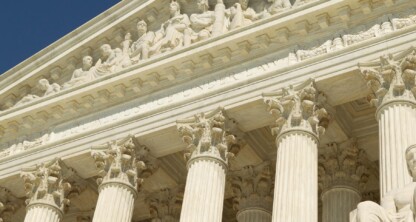
The image shows the facade of the United States Supreme Court building, featuring Corinthian columns and sculpted figures above the entrance—a symbol of justice often referenced by Chicago lawyers specializing in intellectual property law.
March 16, 2026 Tariff & International Trade Resource

What Every Multinational Should Know About …Managing the Aftermath of the Supreme Court’s Historic IEEPA Tariff Decision (Part VIII)

In a recent filing before the CIT, CBP described a new capability being developed within the Automated Commercial Environment (ACE) called CAPE (Consolidated Administration and Processing of Entries).
The image shows the facade of the United States Supreme Court building, featuring Corinthian columns and sculpted figures above the entrance—a symbol of justice often referenced by Chicago lawyers specializing in intellectual property law.
March 16, 2026 Tariff & International Trade Resource

What Every Multinational Should Know About …Managing the Aftermath of the Supreme Court’s Historic IEEPA Tariff Case (Part VII)

The Supreme Court’s ruling rejected IEEPA as a basis for broad tariffs, but it did not call into question tariffs imposed under other trade statutes. That means the decision removed one legal mechanism, not the broader policy goals that drove the tariffs in the first place.
The image shows the facade of the United States Supreme Court building, featuring Corinthian columns and sculpted figures above the entrance—a symbol of justice often referenced by Chicago lawyers specializing in intellectual property law.
March 13, 2026 Tariff & International Trade Resource

What Every Multinational Should Know About …Managing the Aftermath of the Supreme Court’s Historic IEEPA Tariff Decision (Part VI)

For companies that acted as importers of record, the most immediate risk is procedural: failing to take the steps necessary to preserve and secure refund rights. The Supreme Court’s decision does not automatically result in refunds, and the process will be shaped by ongoing litigation at the CIT and potential administrative actions.
The image shows the facade of the United States Supreme Court building, featuring Corinthian columns and sculpted figures above the entrance—a symbol of justice often referenced by Chicago lawyers specializing in intellectual property law.
March 13, 2026 Blogs

What Every Multinational Should Know About…Managing the Aftermath of the Supreme Court’s Historic IEEPA Tariff Decision (Part V)

The conundrum for companies that indirectly paid the IEEPA tariffs, such as those that re-ceived price increases or outright tariff surcharges, is that the importing system is set up so that all refunds will be made by CBP directly to the importer of record. Nonetheless, compa-nies that indirectly paid the IEEPA tariffs may have contractual options, or potentially can use commercial leverage, to seek a refund of some or all of the price increases.
The image shows the facade of the United States Supreme Court building, featuring Corinthian columns and sculpted figures above the entrance—a symbol of justice often referenced by Chicago lawyers specializing in intellectual property law.
March 13, 2026 Tariff & International Trade Resource

What Every Multinational Should Know About…Managing the Aftermath of the Supreme Court’s IEEPA Tariff Decision (Part IV)

Importers of record need to ensure they are best positioned to secure any refunds, while also adapting to the new replacement tariffs. Therefore, on the customs side, we recommend the following steps for importers of record dealing with these issues.
The image shows the facade of the United States Supreme Court building, featuring Corinthian columns and sculpted figures above the entrance—a symbol of justice often referenced by Chicago lawyers specializing in intellectual property law.
March 11, 2026 Tariff & International Trade Resource

What Every Multinational Should Know About…Managing the Aftermath of the Supreme Court’s IEEPA Tariff Decision (Part III)

The importer of record is the entity that initially pays all tariffs and thus is the entity that would receive any IEEPA tariff refunds. Nonetheless, behind the scenes there often are a variety of mechanisms importers of record may have used to handle the often unexpected tariffs, including pushing back on suppliers for price concessions, using surcharges to pass along tariffs, or generally increasing price. In many cases, other parties may be looking to share any potential refunds.