It's Time to Get Going

Notes from the Sidebar Summit at Nasdaq, where the IPO conversation finally stopped being theoretical
Friends,
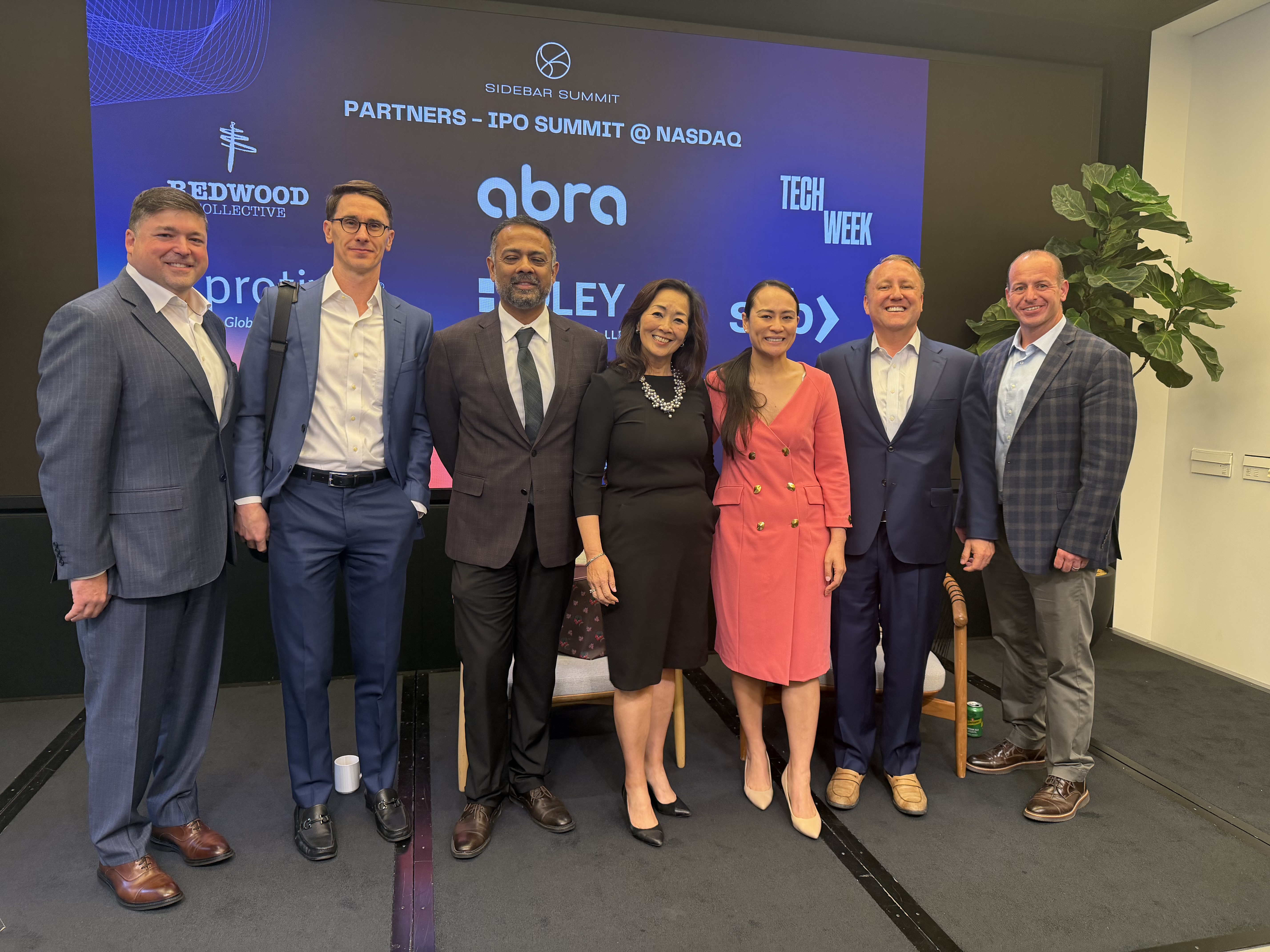
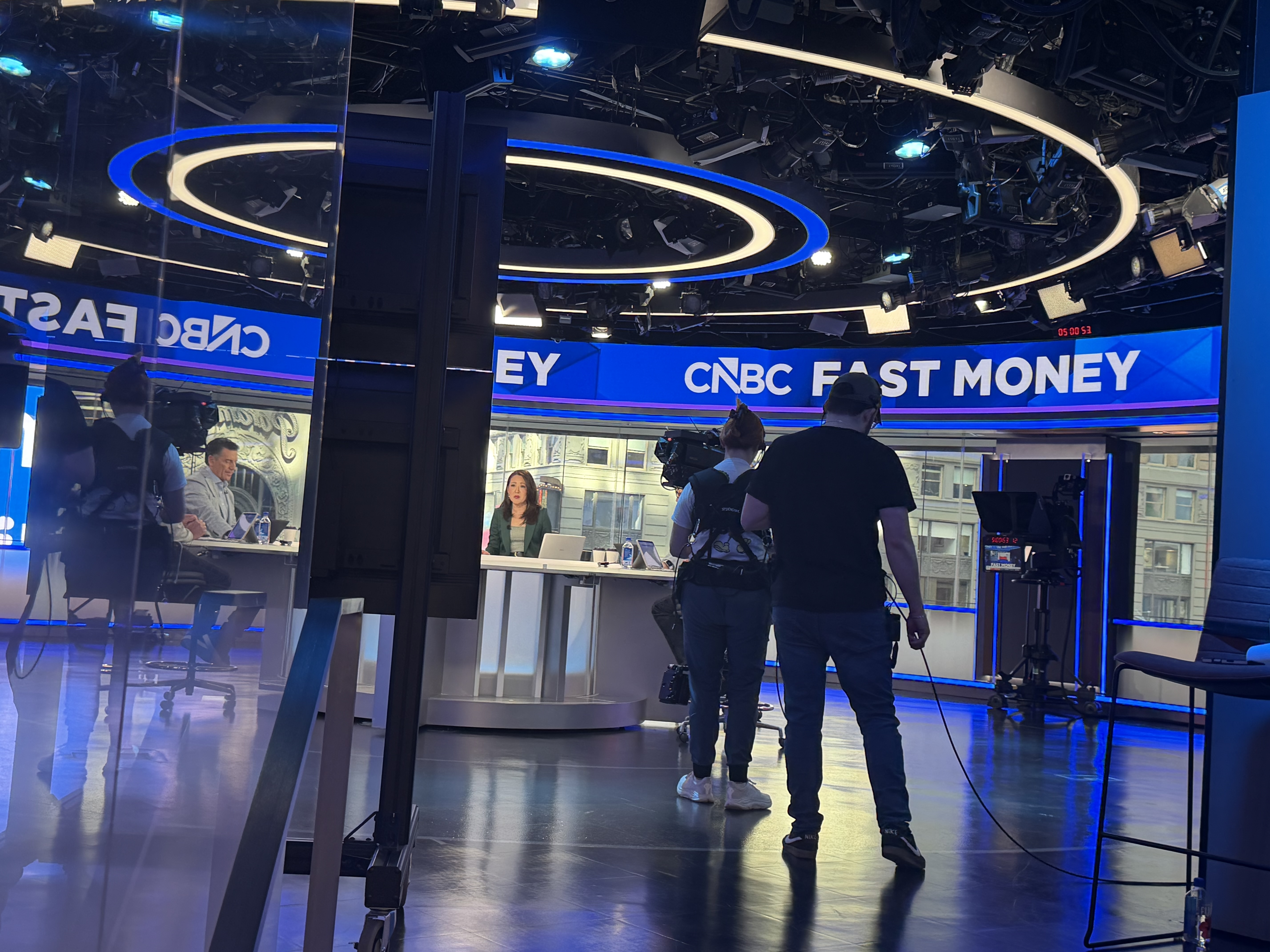
I spent yesterday afternoon in New York at the Nasdaq MarketSite for the Sidebar Summit, and I moderated a panel on markets, AI, and capital formation. Sidebar Summit was part of a series of events comprising New York Tech Week. I want to share what I took away, because the timing of the day turned out to be almost too good to script.
A few hours before I walked on stage, Anthropic filed a confidential S-1 with the SEC. The company behind Claude. Worth something like nine…hundred,,,billion…dollars. Sixty…five …billion…dollars – raised in a single round the week before. The periods are illiteration to make a point. These are giant numbers, and the public statement said almost nothing. No price, no date, no share count. It might go public after the SEC finishes its review, market permitting. That is the whole message.
So I opened with it. I told the room that the most valuable private company most of them have never owned a share of (unless they participated in a pension fund) just started the most expensive game of will-they-won’t-they in history. SpaceX is already on file. OpenAI is reportedly next. Three of the largest offerings ever attempted, all lined up for the same narrow window, and not one of them willing to quote you a price. For the last three years, everyone in a room like that one has told me the IPO market is coming back. It has been coming back the way my flight out of Newark is always about to board. At some point, coming back is just a thing we say to each other.
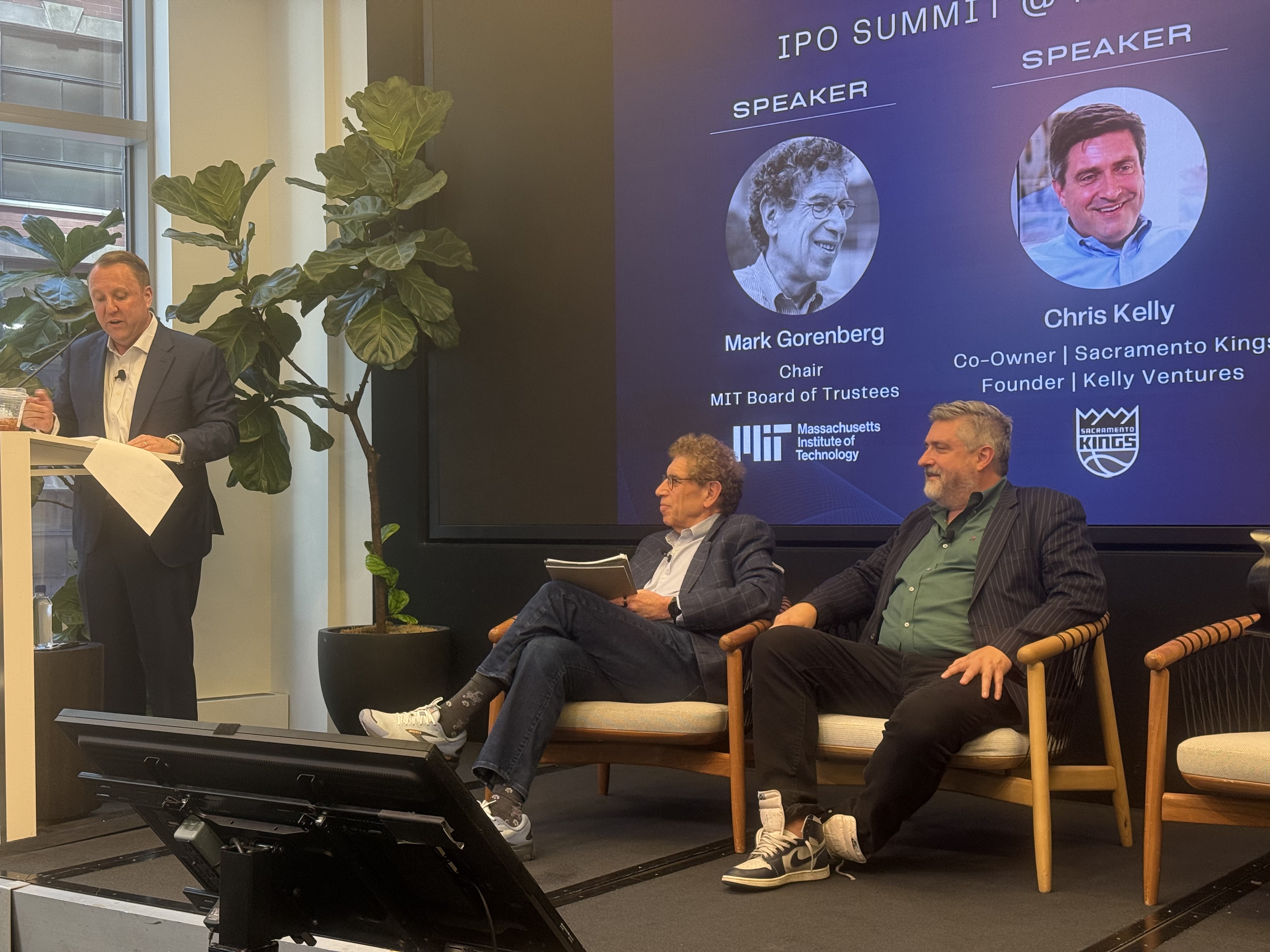
That set up the real question for the next 45 minutes. Is what happened that morning the window finally opening, or is it three companies big enough to kick the door down because the door stopped working for everybody else? And if it is the second one, what does that tell the thousand companies behind them that cannot force anything?
The panel before us framed the stakes
Our session followed a strong panel led by Rob Gould Protiviti on whether and when to go public, with Bill Barhydt of Abra and Aaron Schumm of Vestwell. Bill and Aaron come at the question from very different businesses, but they landed in the same place I keep landing with clients: going public is no longer a milestone you reach because you are supposed to. It is a financing and liquidity decision you make with eyes open, weighed against staying private, against an M&A exit, against the structured secondaries and continuation vehicles that did not exist when I started doing this. The decision has gotten harder, not easier, and companies only do it when they have to.
What my panel actually argued about
I had told the audience there would be no slides and no prepared remarks, and that my panelists disagree with each other on things that matter. They delivered. I will not pretend every exchange resolved cleanly, because it did not, and that was the point.
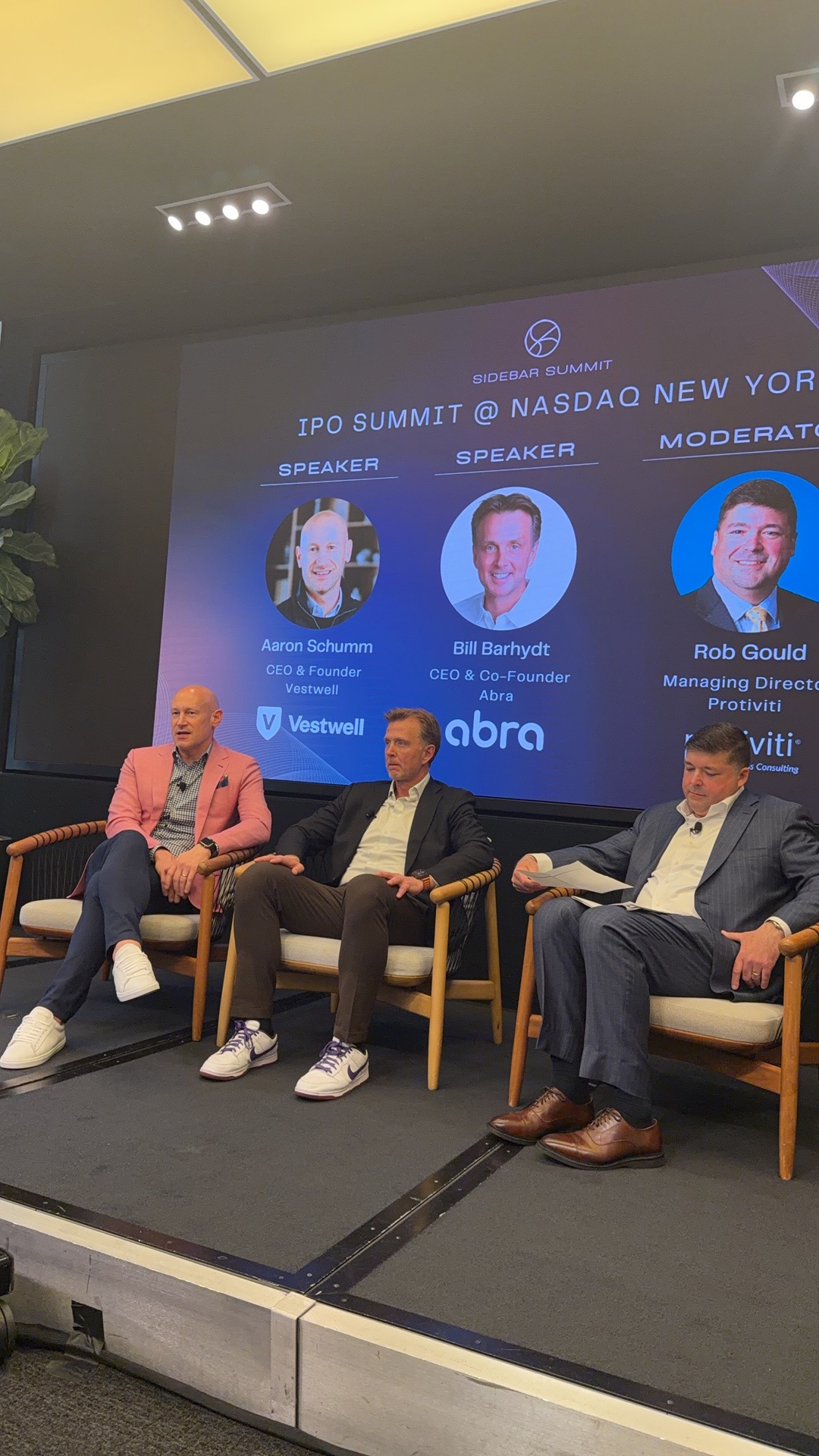
The two lines I am still thinking about both came from the stage.
The first was from Mark Gorenberg, chairman of the MIT board of trustees and founder of Zetta Venture Partners. When the conversation threatened to drift into all the reasons it is hard right now, the cost of being public, the asymmetry of private capital, the policy gridlock, Mark cut through it. His message was simple and he delivered it with the conviction of someone who has watched several technology cycles crest and break. It is time to get going. This is the greatest era we have ever been in, and the best time in the history of the world to form a new technology company. I have heard a lot of market commentary in 25 years of doing this work. That one stuck, because it reframes the entire anxiety of the moment. The structural problems in the public markets are real. They are also not a reason to sit on your hands while the most consequential platform shift of our lifetimes plays out.
The second came from Chris Kelly, and it was advice for founders rather than market color. Test out every new idea. In an era where the cost of building has collapsed and the tools to prototype are sitting on every desk, the constraint is no longer capital or even engineering time. The constraint is willingness to try. The companies that win the next decade will be the ones that ran the most experiments, not the ones that waited for certainty that was never coming.
Put those two together and you have the whole thesis of the afternoon. Get going, and try everything.
The fireside that followed, and a client I am proud of
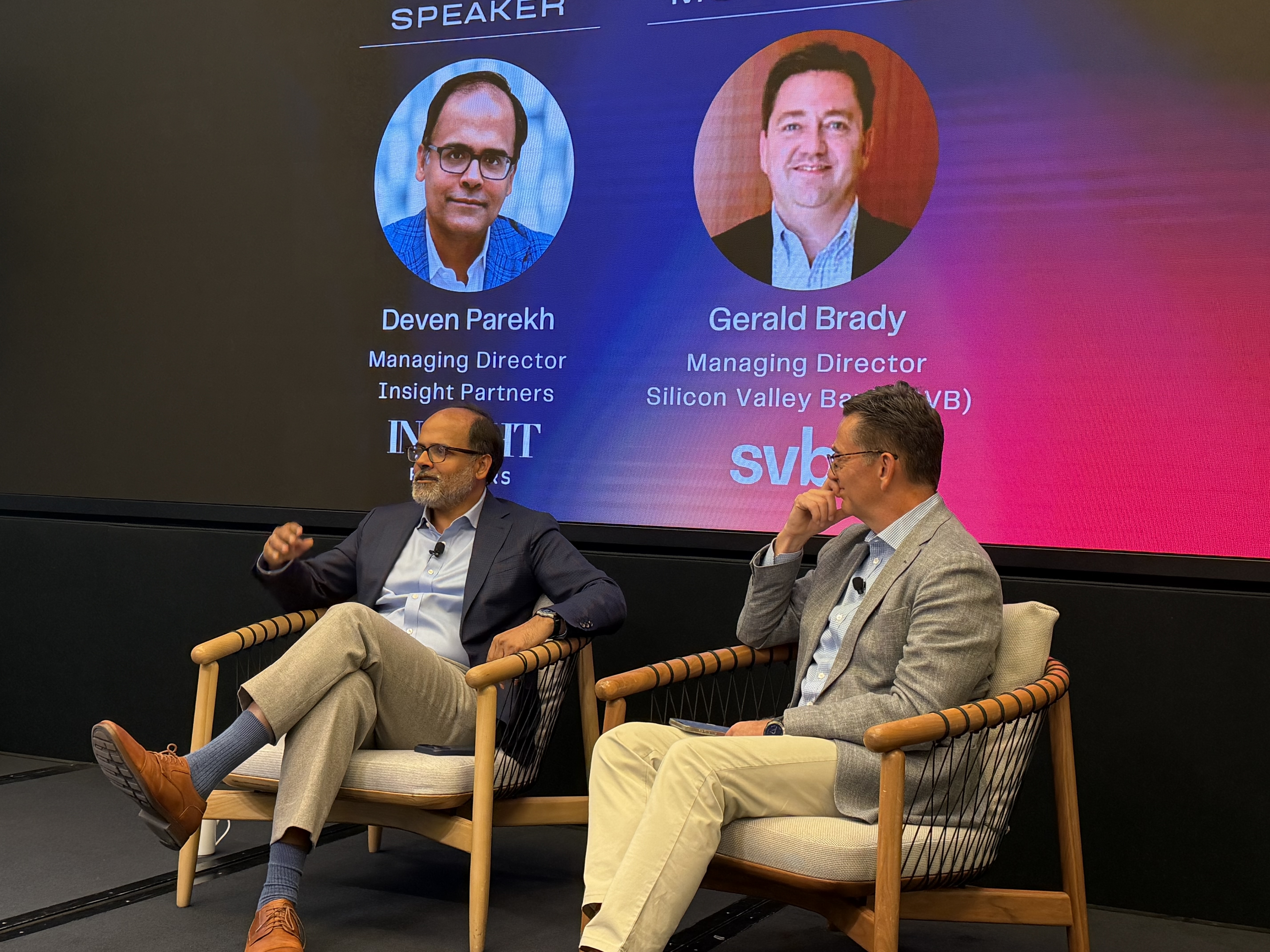
After our panel, Gerald Brady of SVB sat down with Deven Parekh of Insight Partners for a fireside chat, and I will admit I enjoyed it for a slightly self-interested reason. Insight backed our client Mirantis, and I got to brag a little. Mirantis spent more than a decade as a cloud infrastructure company, then executed a genuine pivot into AI, and last month sold to IREN in an all-stock deal valued at roughly $625 million in stock as of signing. IREN is using the acquisition to climb the stack from raw GPU capacity into full AI cloud delivery, and Mirantis brought the orchestration software, the enterprise customer base, and the operational depth to make that credible. It is exactly the kind of outcome this market is supposed to produce and too rarely does: a company that read where the puck was going, made a hard pivot, and found the right home at the right time. The Insight team helped get them there.
Which brings me to the part I could not stop talking about
I came into the day a structural skeptic about the IPO machine, and I left one. Filing is not pricing. A confidential draft starts a clock and commits to nothing. The gap between the three giants tiptoeing toward the public market and the founders sitting in that audience wondering when their own window opens is the gap that policy still has not fixed. And it is worth being honest about why that gap exists, because the answer is not the one most people reach for.
The public market has been shrinking for thirty years. The number of U.S.-listed companies has fallen from roughly 8,000 in the mid-1990s to about 4,000 today. The capital did not vanish. It moved to the private markets, which now sit on something like $8.5 trillion and ask for almost none of the disclosure or accountability the public markets require. A generation of growth has happened in a room most Americans are not allowed to enter. The teacher and the firefighter saving through a 401(k) get to buy in late, after the best gains have already been distributed to a narrow set of insiders. That is the real cost of the shrinking public square.
SEC Chairman Paul Atkins has made reversing the trend the center of his agenda, under the banner “Make IPOs Great Again,” and in a single month this spring, the SEC turned that slogan into actual rulemaking. Semiannual reporting as an option. Shelf registration opened to nearly every company instead of just the giants. A simpler filer framework, relief from the most expensive recurring audit ritual, a multi-year on-ramp for the newly public, and a withdrawal of the climate-disclosure rules a federal court had already paused. I support all of it. Then on May 26, the Chairman went to Stanford and opened a comment file asking for bold and creative ideas to modernize how companies go public. That invitation matters as much as the rules.
But here is the uncomfortable truth, and it is the thing I kept pressing on stage. Companies do not avoid the public markets mainly because reporting is expensive. They avoid them because the private markets now offer everything a growing company needs with none of the friction. You cannot draw companies back by discounting the rent when the alternative is unlimited and unregulated. Lowering the cost of being public is half the job. The other half is removing the barriers that keep companies from going public in the first place, and on that, the work has barely begun.
So when people ask me what I would actually add to the agenda, here is my list.
- Rewrite the gun-jumping rules. The rules governing what a company can say while going public were written in 1933 and last meaningfully touched in 2005. They force a company into silence at the exact moment investors most want to hear from it, and they turn ordinary communication into a minefield only expensive counsel can cross. Rebuild the whole thing around one principle: police fraud, not the act of speaking.
- Revive research and trading for smaller companies. Wall Street has almost no economic reason left to publish research on, or make markets in, anything outside the largest names. You can see the result in the concentration of the market, where seven companies made up roughly a third of the S&P 500 at the end of last year. A company that goes public only to find no analyst covering it and no real market in its shares has little reason to be public at all. Let smaller issuers choose wider trading increments, and support the firms willing to commit capital to make markets in their stock.
- Fix the litigation calculus. A company doing an IPO is exposed to a class of securities suits that seasoned public companies are largely shielded from, and the safe harbor that lets mature companies discuss their projections in good faith does not extend to the companies that need it most. Until honest forecasting is something a newly public company can do without inviting a strike suit, the math will keep pushing companies private.
- Modernize the path to listing. After the Supreme Court’s 2023 decision in Slack Technologies v. Pirani, the heavy registration statement once required for a direct listing adds cost without adding much protection. Streamline it. And rehabilitate, rather than bury, the SPAC and the alternative public offering. Both are legitimate routes to the public market that the current rules treat as second-class.
- Make the giants disclose. There is no good reason a company that has raised a billion dollars or more in private capital should sit outside the public reporting system. The money funding those companies comes from pension funds, endowments, insurers, and the vehicles managing ordinary Americans’ retirement savings, which are exactly the investors the securities laws exist to protect. A company of that size is public in substance. It should disclose like one, on terms fitted to its circumstances rather than copied wholesale from the rules for a Fortune 100 issuer. I will let you decide which company that filed a confidential draft this morning might have something to say about that.
- Welcome the world. America’s share of global IPOs has fallen sharply over two decades. An agenda serious about capital formation cannot treat foreign issuers as an afterthought. We should be competing to list the world’s growing companies here, not narrowing the door.
The takeaway
Put it together and you get the through-line of the whole afternoon. Mark is right that this is the best time in history to build, and that the only unforgivable move is to wait. Chris is right that you test every idea, because the cost of trying has never been lower. And the policy job is to make sure that when those companies are ready, there is a public market worth going to, one that ordinary Americans can actually invest in.
The May agenda is the most serious attempt in a generation to reopen the U.S. public markets, and it deserves broad support. But finishing the job means fixing the rules that keep companies out, not just discounting the rent for the ones already inside. The comment windows close this summer. If you want a deeper, more open public market, this is the moment to say so on the record.
Get going. Test everything. And help us finish the job.
More soon.
Thanks to Vishal Verma and the Sidebar Summit team for producing a great event.
Louis Lehot is a partner at Foley & Lardner LLP based in Silicon Valley, where he advises entrepreneurs, investors, and public companies on corporate, securities, capital markets, and M&A matters. He has more than 25 years of experience guiding companies from formation to IPO and beyond.
Opinions are the author’s own and not those of his firm. This is commentary, not legal advice. Attorney advertising. Prior results do not guarantee a similar outcome.