What Is a General Counsel Worth?


Between the two of us, we have spent a long time in Silicon Valley sitting next to general counsels at the moments that matter: the term sheet, the IPO, the sale, the hard quarter. We have watched many of them negotiate for the company with real skill. We have watched far fewer of them negotiate for themselves.
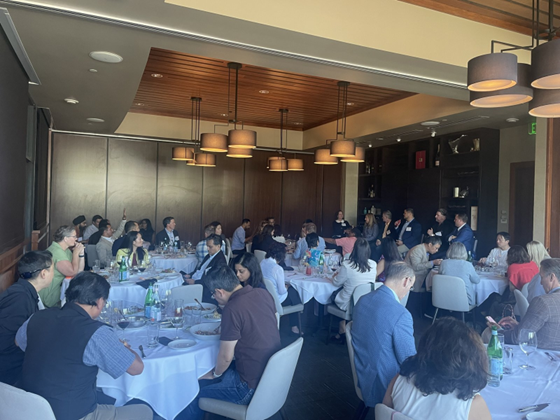
That gap is why we put this lunch together. Last Friday, Foley & Lardner hosted a private gathering of general counsels and chief legal officers from public and late-stage private companies (even some investment fund general counsel were in the room). The topic was one that rarely gets discussed out loud: what GCs are actually paid, how that compares to the rest of the C-suite, and how to negotiate a package that reflects the real scope of the job. We talked about strategy at four stages of a career. On the way in. When something big happens. As the role grows. And when it is time to move on.
We moderated together, and we asked four people who see the question from different seats to join us:
- Janice Roberts, Partner at Benhamou Global Ventures and Chair of the Compensation Committees at Zebra Technologies and Netgear, who brought the board’s view
- Courtney Yu, Director of Research at Equilar, who brought the data
- Matthew Zinn, former Chief Legal Officer of Matterport, who brought the in-house experience
- Sean Burke, Founding Partner of Whistler Partners, who brought the recruiter’s read on the market
The room was full of friends, and the conversation started before anyone picked up a microphone. Once we did, it moved fast. Here is what stood out.

1. The numbers are moving, and they are moving up
We started with the data, because that is where any honest conversation about pay should start.
For years the story was that the general counsel was the last one to the table on C-suite pay. Courtney’s numbers show that story has changed. Across the Equilar 500, the 500 largest U.S. public companies by revenue, median total compensation for the general counsel has risen every year since 2021. It went from $3.0 million that year to $3.7 million in 2025. That is a gain of about 23% over five years. The biggest single step came last year, when the median jumped from $3.4 million to $3.7 million, roughly 9% in one year.
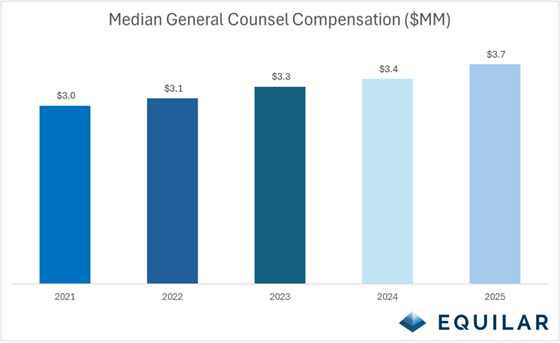
Two details in Courtney’s data caught the room’s attention. Bay Area companies posted the largest increases. And women general counsels are now, on the median, paid more than men. Neither of those would have been true a decade ago.
The picture still varies by company size, sector, and whether the GC also owns compliance, privacy, or the corporate secretary function. But the direction is clear.
Janice put the practical point plainly. When a GC asks “what should I be making,” the answer starts with peer-company data. It does not start with a company’s insistence that it is a unique snowflake.
2. The money is shifting toward equity
If the data tells you where the market is, a recruiter tells you where it is going. Sean sees hundreds of these negotiations a year, and he described a market that has moved past base-and-bonus. Today the conversation turns on equity: the size of the grant, sign-on awards, and make-whole packages for the equity a candidate leaves behind. The structures differ a great deal between public and private companies, and a candidate who does not understand the difference is negotiating blind.
Matthew has lived the trade-off. He took equity at Matterport, rode it through the company’s life as a public company, and saw it through the sale to CoStar Group. His advice was blunt. “You have to believe in the company to believe in the equity. If you don’t believe, you should leave.”

3. The best terms are often not the dollar figures
Equity and cash get the attention, but some of the most useful advice of the afternoon was about the terms that do not show up in a headline number: the reporting line, access to the board, title, the scope of the role, severance, and change-of-control protection. Those terms often decide whether a package was a good one long after the salary is forgotten.
Janice told candidates to focus on the scope of the role and on the value they bring that no one else in the room can. Matthew added two filters of his own. Take the job that reports to the CEO. And take the job where the personal fit is strong, because no package survives a bad one.
We asked each panelist to name the most common negotiating mistake they see. The answers all pointed the same way. Assuming the company will take care of you is not a strategy.
That led to a lively exchange about the extra hats a GC is often asked to wear: chief people officer, head of security, and a long list of administrative roles. The panel’s view was that these jobs rarely come with much extra pay. What they do build is a résumé, and a case for the next role.

4. How boards decide whether the GC creates value or costs money
Janice chairs two public-company compensation committees, so she was able to give the room something rare: a look at how the decision actually gets made. Boards compare the GC against the CFO and the chief revenue officer. They ask what changed. And they notice when a GC ties legal outcomes to the business, whether that is a clean acquisition, a resolved enforcement matter, or a risk that never became a headline.
Her message to sitting GCs and candidates alike was direct. Boards expect you to negotiate. They expect you to make the best case for the best package, and they expect to cut it back. That is how the process works. If you don’t ask, you don’t get.
We also raised the harder question of whether better-paid GCs deliver measurably better outcomes: fewer enforcement actions, cleaner deals, lower litigation costs. Nobody claimed to have settled it. The truth is that we are still asking a spreadsheet to put a price on prevention.
5. AI governance is now part of the job, and part of the price
We closed the substantive discussion with the newest line item on the GC’s plate. Artificial intelligence has arrived in every company represented in the room, and with it a set of risks that the legal department is being asked to own. The panel worked through when a GC should hold the AI governance framework outright, and when sharing it with security, compliance, and the business is the better answer. We talked about what boards and investors want to hear before they stop raising an eyebrow. And we asked whether “AI fluent” is becoming a real line on the hiring scorecard. The consensus was that it already is, and that the market has not yet decided what to pay for it.
Closing round: the one thing we wish we had known
We ended by asking each panelist for the one thing they wish they had understood about compensation earlier. One answer summed up the whole afternoon. Cash pays the monthly bills. Equity is the only part of the package that builds wealth. So the GC has to believe in the company, and has to be willing to bet on it.

Thank you
Our thanks to Janice, Courtney, Matthew, and Sean for their candor, and to every GC who joined us and stayed for the conversation over dessert. Everyone left with a Happy Lawyers Club cap. We hope they also left with a sharper sense of what they are worth, and a plan to raise it over time.
If you could not join us and would like to talk through any of this, or benchmark your own package, we would be glad to hear from you.
Event page: https://news.foley.com/cv/e030e1fc670f9f7ad1d886a3bfd74e34994fde56
This post is for general informational purposes and does not constitute legal advice.