



SPAC 4.1: Plenty of SPACs, Plenty of Targets — So Who Is Paying for the Deal?

A year ago, we argued that SPACs had entered a fourth, more disciplined era: experienced sponsors, longer search periods, promotes tied to performance, and targets with real revenue.[1] Twelve months on, that thesis has held. This article discusses where the bottleneck would move.
In 2021 the scarce resource was a credible target. In 2026, it is committed cash at closing. There are plenty of SPACs and plenty of companies that want to use them. What there is not, outside a narrow band of sectors, is a PIPE.
How the money moves
A SPAC is a company with no business — a management team, a pile of cash and a deadline. The team sells units, usually a share bundled with a fraction of a warrant, to the public at $10 each. Nearly all of the proceeds go into a trust invested in short-term U.S. government securities. The team then has 12 to 24 months under its charter to find a private company to buy, extendable by sponsor deposits or a shareholder vote, and 36 months at the outside under the exchange listing rules.[2]
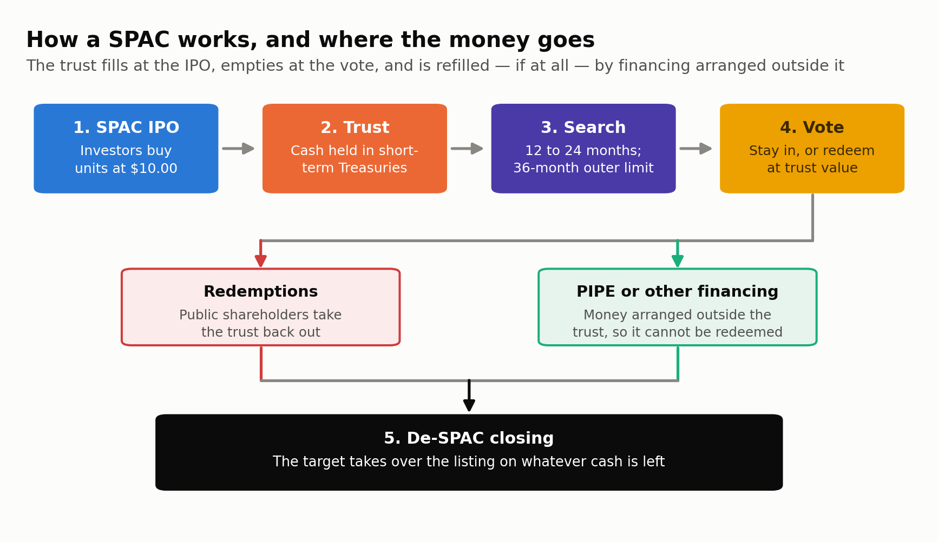
Read it left to right: the trust fills at the IPO, empties at the vote, and is refilled — if at all — by money arranged outside it.
The catch is in the fine print. When a deal is announced, every SPAC shareholder gets a choice: stay in and own a piece of the new company, or hand back the shares and take a pro rata share of the trust (referred to as a redemption). In 2021 most investors stayed. Today most leave. In every quarter of 2025, the median de-SPAC lost more than nine public shares in ten.[3] Many of today’s SPAC investors appear to buy at the IPO already planning to cash out at the vote. To them the trust is a savings account with a free lottery ticket attached.
Here is what that does to a typical trust. The average SPAC raised about $211 million in 2025, and the average across 2026 pricings has slipped to roughly $176 million.[4]
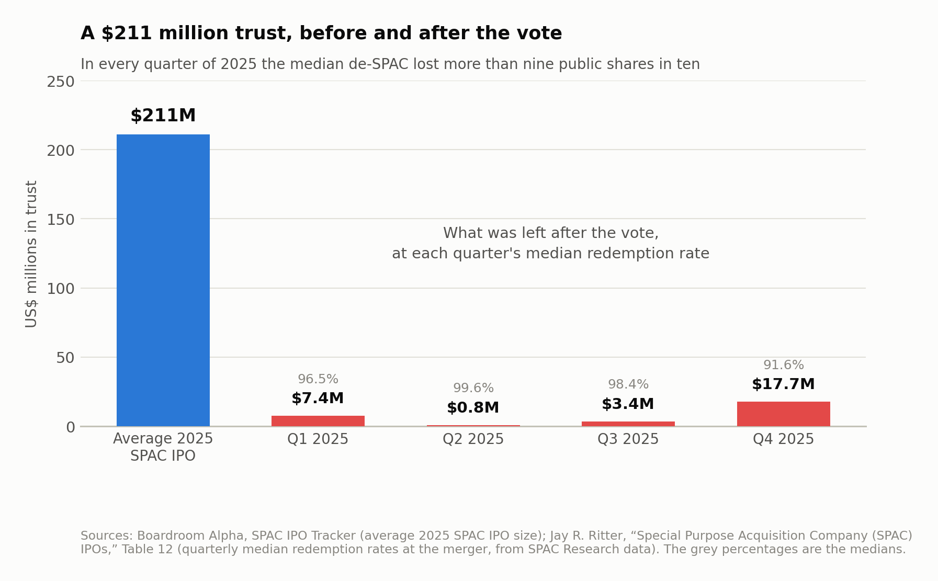
The bar on the left is the average 2025 SPAC IPO. The four on the right are what would have survived at each quarter’s median redemption rate.
Why the PIPE existed, and why the checks stopped
Redemptions are why the PIPE — private investment in public equity — exists. Before announcing a merger, the SPAC lines up large investors who contract to buy new shares when the deal closes, conventionally at the same $10 the public paid. Their money is not in the trust, so it cannot be redeemed. This gives the target additional comfort on the certainty of the closing as the target would then know that even if every public shareholder leaves, a set amount of cash will be there on day one.
The PIPE does two more jobs. It sets the price: when serious funds agree to pay $10 a share before a deal is announced, the market reads that as evidence the valuation is real. And it fills the balance sheet. A company going public wants growth money, not just a ticker symbol.
In the boom earlier in this decade, PIPEs were the engine. In 2021, 613 SPACs raised roughly $145 billion on the Renaissance Capital and Ritter counts, though the SEC, citing SPAC Analytics, reports $162.5 billion.[5] SPACs were about 59 percent of U.S. listings by number, and about half by proceeds.[6] Barely 5 percent of that year’s de-SPACs closed without outside financing.[7]
Then the bust. Companies that went public through SPACs in 2020 and 2021 were down more than 60 percent on average by December 2022, measured from the $10 trust price. Traditional IPOs of the same vintage were themselves down 36 percent, so the SPAC shortfall against that benchmark was 26 points rather than the whole decline — a distinction the headlines rarely draw.[8] Of roughly 300 companies that completed SPAC mergers through 2022, 85 percent were trading below their IPO price when FTI Consulting counted in mid-2024, and the share would be higher if delisted and bankrupt companies were included.[9] The funds that wrote those PIPE checks took the losses. Many decided not to write them again.
Three things then finished the job. First, performance. At this year’s SPAC Conference, every surveyed attendee named post-merger trading as the market’s biggest challenge, and 69 percent were unhappy with recent de-SPAC results.[10] Nobody writes a $100 million check at $10 a share into that mood.
Second, the one pool of PIPE money that opened in 2025 closed almost as fast. Crypto-treasury companies, which hold bitcoin and other digital assets on the balance sheet, briefly became SPAC favorites. Ten such mergers were announced, two closed, and then a crypto sell-off pushed the group from premiums to discounts to net asset value, leaving the other eight pending as of March 2026.[11] At least one has since been abandoned: Cantor Equity Partners I and Bitcoin Standard Treasury terminated in August 2026.[12]
Third, the market turned. Sponsors paused this spring as investors digested AI’s hit to software stocks and the war with Iran. The trigger came in early February, when Anthropic released agentic tools aimed at professional workflows; Reuters put the resulting six-session decline at nearly $1 trillion across global software and services stocks.[13] The crossover funds that once anchored SPAC PIPEs are the same funds nursing those losses.
The survey captured the result. Fifty-seven percent of participants said PIPE terms are the most important factor in judging a deal. Fewer than 10 percent pointed to target quality, valuation or sponsor experience.[14] The financing is now the deal.
Plenty of SPACs, plenty of targets
The current supply of vehicles is the strongest since the boom. In 2025, 144 SPAC IPOs raised more than $30 billion[15], and through late September 2026 another 152 had priced, raising about $26.8 billion.[16] At the end of March, 226 SPACs were searching for a target, holding $43.7 billion in trust.[17]
Targets are not scarce either. Boardroom Alpha counted 124 announced deals in the pipeline in late September.[18] Private equity and venture portfolios are full of companies past their planned exit dates. In our own practice, inbound calls from both sponsors and targets have never been heavier. So both sides of the table are crowded. The empty chair is the one marked “financing.”
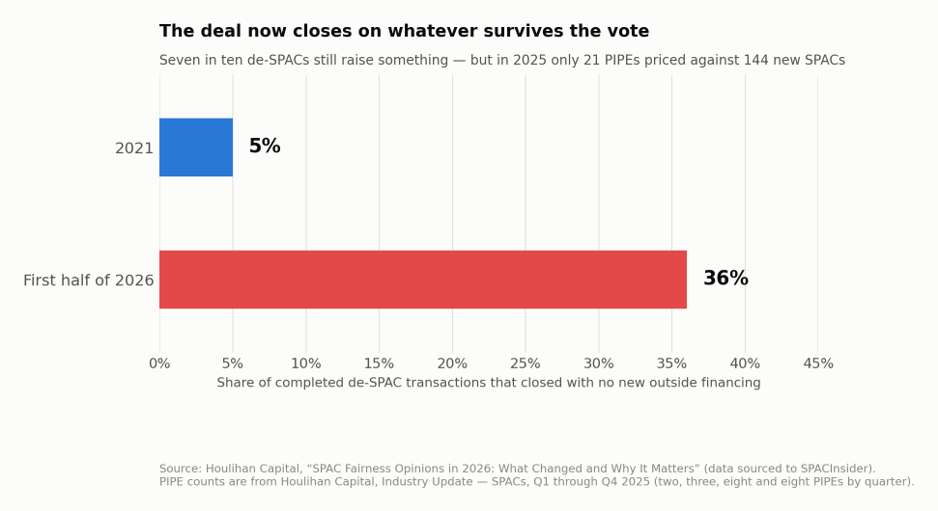
The trust is full, the exit door is open, and the backstop that used to catch the deal is thin.
So how do deals actually get done?
By treating the PIPE as one tool among many rather than the closing condition. Six patterns recur in this year’s closed and pending deals.
Close on less cash. About 36 percent of de-SPACs in the first half of 2026 closed with no new outside financing at all, against roughly 5 percent in 2021.[19] Minimum cash conditions are sized to what survives redemptions, and target holders cover the shortfall by taking more stock instead of cash. The de-SPAC becomes a listing, not a capital raise. The raise comes later.
Non-redemption agreements. Sponsors pay holders not to redeem, in founder shares rather than cash. In one 2025 arrangement, DT Cloud Star Acquisition Corp.’s sponsor agreed to transfer 200,000 founder shares at closing to a holder who agreed not to redeem 600,000 shares at an extension vote.[20] That is one free share for every three held, paid out of the promote. It works, and it dilutes everyone else.
Prepaid forward purchase agreements. Live Oak V and Teamshares, and GigCapital7 and Hadron, each paired non-redemption agreements with prepaid forwards, and both closed in 2026.[21] A counterparty buys shares from holders who would have redeemed and settles up later. In both deals the prepayment was funded out of the trust, so the structure preserved the share count against a minimum cash condition rather than delivering new money to the company — and the stock still carries an overhang, sharpened by reset mechanics that reprice the counterparty’s economics downward as the shares fall.
Backstops and structured PIPEs. Sponsors, anchor investors and strategic partners commit to buy shares only if redemptions push cash below a floor. And where a PIPE exists at all, it is rarely plain common stock: convertible notes and preferred give investors downside protection, but conversions weigh on the stock right after closing.[22]
Raise after the listing. Equity lines have become a common post-close facility, letting the company sell stock in small pieces to a committed buyer as it needs cash. Newsmax signed a $1.2 billion standby facility in 2025; most de-SPAC lines are a fraction of that.[23] In May 2026 the SEC proposed an overhaul of the registered offering framework that would drop the one-year reporting history now required for Form S-3, which would let a company emerging from a de-SPAC use a shelf immediately and make “list now, raise later” materially cheaper.[24] The proposal has not been adopted.
In-kind and strategic money. The Bitcoin Standard Treasury deal took roughly $600 million of its PIPE in bitcoin rather than cash — 5,021 bitcoin, alongside up to $1.5 billion of fiat-denominated financing — yet the shareholder vote was postponed three times while terms were renegotiated, and the parties ultimately terminated.[25] Strategic money solves the check-size problem. It does not solve the confidence problem.
When a real PIPE does show up, it now does a different job. A PIPE signed before the deal is announced validates the valuation; one raised afterward is just extra cash. The sectors where anchors still write checks — infrastructure, defense, data centers and digital assets — share one trait: revenue that exists today. That is last year’s discipline thesis, restated as a financing rule.
What this means
For sponsors: line up the financing before the letter of intent, not after, and size the target to the trust. The exchanges’ 80 percent test is a floor, not a target, and dilution drives the math.[26]
For targets: a SPAC nearing its deadline is a motivated seller, and founder shares are negotiable. But a listing without capital is a liability, not an asset. Model the post-closing float, the forward and convertible overhang, and the cost of the equity line before you sign.
For both: every tool above moves value from one pocket to another, and each of them, if material, must be described in the de-SPAC disclosure documents under the SEC’s 2024 SPAC rules — principally Items 1603 through 1605 of Regulation S-K — and is separately reportable on Form 8-K.[27] The plaintiffs’ bar reads proxy statements. The litigation risk we flagged last year now lives in the financing annex.[28]
The bottom line
SPAC 4.0 fixed the target problem. SPAC 4.1 has to fix the capital problem. The vehicles are there and the companies are there. The sponsors who thrive will be the ones who stop asking “who will PIPE this?” and start engineering the close from the redemption line up.
[1]Louis Lehot & Alexandre Turqueto, SPAC 4.0: From Spectacular Failures to a Disciplined Renaissance, Foley & Lardner LLP (Sept. 30, 2025), https://www.foley.com/insights/publications/2025/09/spac-4-0-from-spectacular-failures-to-a-disciplined-renaissance/.
[2]Nasdaq IM-5101-2; NYSE Listed Company Manual § 102.06, https://listingcenter.nasdaq.com/rulebook/nasdaq/rules.
[3]Jay R. Ritter, Special Purpose Acquisition Company (SPAC) IPOs, Table 12 (updated July 10, 2026), https://site.warrington.ufl.edu/ritter/files/IPOs-SPACs.pdf.
[4]Boardroom Alpha, SPAC IPO Tracker, https://www.boardroomalpha.com/spac/ipos.
[5]Renaissance Capital, US IPO Market: 2021 Annual Review (Jan. 2022), https://www.renaissancecapital.com/review/2021USReview_Public.pdf; Ritter, supra note 3, Table 15b; Special Purpose Acquisition Companies, Shell Companies, and Projections, Release Nos. 33-11265; 34-99418; IC-35096 (Jan. 24, 2024), 89 Fed. Reg. 14158 (Feb. 26, 2024), Table 1 n.25, https://www.sec.gov/files/rules/final/2024/33-11265.pdf.
[6]Nasdaq, A Record Year for IPOs in 2021, https://www.nasdaq.com/articles/a-record-year-for-ipos-in-2021.
[7]Houlihan Capital, SPAC Fairness Opinions in 2026: What Changed and Why It Matters, https://www.houlihancapital.com/spac-fairness-opinions-in-2026-what-changed-and-why-it-matters/.
[8]Michael Klausner & Michael Ohlrogge, Was the SPAC Crash Predictable?, 40 Yale J. on Reg. Bull. 101 (2023), https://www.yalejreg.com/wp-content/uploads/Michael-Klausner-Michael-Ohlrogge-Was-the-SPAC-Crash-Predictable-40-Yale.-J.-on-Regul.-Bulletin-101-2023.pdf.
[9]Michael Eisenband, Not Even a Raging Bull Market Can Rescue SPACs, FTI Consulting (July 9, 2024), https://www.fticonsulting.com/insights/articles/not-even-raging-bull-market-can-rescue-spacs.
[10]SPAC Conference 2026 Market Survey, DealFlow Events (June 18, 2026), https://www.accessnewswire.com/newsroom/en/publishing-and-media/spac-conference-2026-market-survey-pipe-funding-remains-crucial-to-successful-1179045.
[11]Renaissance Capital, DAT SPAC: The crypto sell-off has punished digital asset treasury companies (Mar. 10, 2026), https://www.renaissancecapital.com/IPO-Center/News/117578/DAT-SPAC-The-crypto-sell-off-has-punished-digital-asset-treasury-companies-.
[12]Cantor Equity Partners I, Inc., Current Report (Form 8-K) (Aug. 20, 2026), https://www.sec.gov/Archives/edgar/data/2027708/000121390026092163/ea0302895-8k_cantor1.htm.
[13]Chibuike Oguh, Danilo Masoni & Medha Singh, Selloff wipes out nearly $1 trillion from software and services stocks as investors debate AI’s existential threat, Reuters (Feb. 4, 2026), https://finance.yahoo.com/news/global-software-stocks-hit-anthropic-120659089.html; Louis Lehot, Private Equity’s Hard Year Has Real Openings, Foley & Lardner LLP (Sept. 21, 2026), https://www.foley.com/insights/publications/2026/09/private-equitys-285-billion-shock-year-still-has-real-openings/.
[14]SPAC Conference 2026 Market Survey, supra note 10.
[15] SPAC Insider, https://www.spacinsider.com/data/stats
[16]Boardroom Alpha, SPAC IPO Tracker, supra note 4.
[17]Houlihan Capital, Industry Update — Special Purpose Acquisition Companies, Q1 2026, https://www.houlihancapital.com/wp-content/uploads/2026/08/Q1-2026-SPAC-Report-v2.pdf.
[18]Boardroom Alpha, DeSPAC Tracker, https://www.boardroomalpha.com/spac/despacs.
[19]Houlihan Capital, SPAC Fairness Opinions in 2026, supra note 7.
[20]DT Cloud Star Acquisition Corp., Current Report (Form 8-K) (Oct. 22, 2025), https://www.sec.gov/Archives/edgar/data/2017950/000149315225018928/form8-k.htm.
[21]Live Oak Acquisition Corp. V, Current Report (Form 8-K) (June 1, 2026), https://www.sec.gov/Archives/edgar/data/2048951/000121390026063576/ea0292781-8k425_liveoak5.htm; GigCapital7 Corp., Current Report (Form 8-K) (May 7, 2026), https://www.sec.gov/Archives/edgar/data/2023730/000119312526211817/d152235d8k.htm.
[22]Cantor Equity Partners I, Inc., Current Report (Form 8-K), Ex. 99.1 (July 22, 2025), https://www.sec.gov/Archives/edgar/data/2027708/000121390025064927/ea024932301ex99-1_cantor1.htm.
[23]Newsmax Inc., Current Report (Form 8-K) (Apr. 7, 2025), https://www.sec.gov/Archives/edgar/data/2026478/000121390025029186/ea0237300-8k_newsmax.htm.
[24]Registered Offering Reform, Release Nos. 33-11418; 34-105513; IC-36160 (May 19, 2026), 91 Fed. Reg. 31022 (May 26, 2026), https://www.federalregister.gov/documents/2026/05/26/2026-10373/registered-offering-reform.
[25]Cantor Equity Partners I, Inc., Form 8-K, Ex. 99.1, supra note 21.
[26]Nasdaq IM-5101-2; NYSE Listed Company Manual § 102.06, supra note 2.
[27]17 C.F.R. §§ 229.1603–229.1605, https://www.ecfr.gov/current/title-17/chapter-II/part-229/subpart-229.1600; Form 8-K, Item 1.01.
[28]Delman v. GigAcquisitions3, LLC, 288 A.3d 692 (Del. Ch. 2023), https://courts.delaware.gov/Opinions/Download.aspx?id=342240; Solak v. Mountain Crest Capital LLC, C.A. No. 2023-0469-SG (Del. Ch. Oct. 18, 2024), https://law.justia.com/cases/delaware/court-of-chancery/2024/ca-no-2023-0469-sg.html.