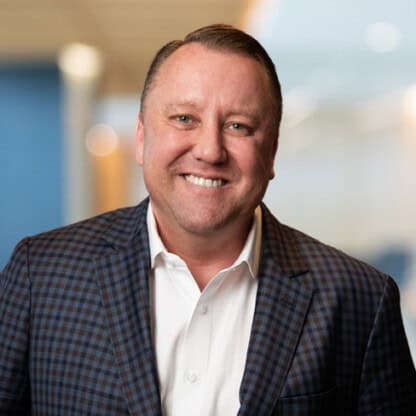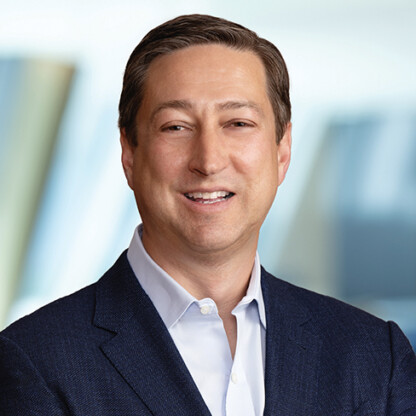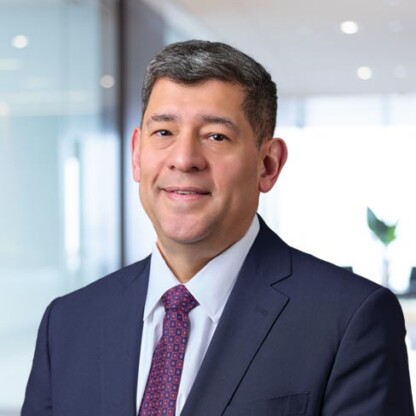
Three of us spent last week in Beverly Hills for the Milken Institute Global Conference. The official sessions ran May 3 through 6 across the Beverly Hilton and the Waldorf, under the banner “Leading in a New Era.” As always, the more useful conversations happened in the side rooms, the hotel suite meetings, and the Tuesday night party we sponsored. A few things we are bringing back to clients.
Jensen on Monday
Jensen Huang’s fireside with Becky Quick was the hottest ticket of the day. Room was over capacity, long line down the Hilton hallway, no chance of getting in late. Three points stuck with us.
First, his framing of AI as “the five-layer cake” rather than a model. AI is infrastructure, not software, and you should be diligencing exposure at every layer of the stack. Useful frame for anyone underwriting an AI-adjacent target.
Second, his pushback on AI job-loss narratives. He drew a real distinction between automating a task and eliminating a role, and said the doom rhetoric (much of which, he noted, comes from inside the AI industry) risks making Americans disengage from the technology entirely. Clients who want us to load up employment reps with AI-displacement language should think hard about how much weight that actually carries.
Third, on geopolitics. He was clear that China should not have access to Nvidia’s most advanced chips, and that US companies have no business blocking lawful government use of AI for national security. The second part read as a direct shot at Anthropic’s stated posture. Worth tracking if you are advising dual-use clients on procurement work.
Fink and Flatt on Tuesday
The most useful session of the week was Larry Fink’s panel with Brookfield’s Bruce Flatt, moderated by Mike Milken. Fink’s headline call: there is no AI bubble. There is the opposite of one. The US is short power, short compute, and short chips. He put the capex need at roughly $10 trillion this decade and made the obvious follow-on point that governments running structural deficits cannot fund this themselves, which puts the build on the private sector. He also previewed a BlackRock partnership with an unnamed hyperscaler on a 1-gigawatt data center, to be announced later in the week.
The forward call worth flagging: Fink expects a new asset class to emerge in compute futures. Forward contracts on raw computing power, priced the way markets currently price energy and agricultural commodities. There is no regulated venue for that yet. But if BlackRock is teeing it up on stage at Milken, it is closer than most people think. Quietly an interesting derivatives, tax, and ERISA project for somebody.
For our funds clients, the more practical Fink point was on retirement capital. Over half of BlackRock’s $14 trillion is retirement money. The DOL’s March 30 proposed rule on private credit access for defined contribution plans is the next real battleground. Fund managers raising vehicles built to tap that channel should be in front of ERISA counsel now, not later.
Flatt’s complement was useful in its own right. 50% of Brookfield’s $1.2 trillion private credit book sits in asset types that were not investable 15 years ago. He expects that share to reach 75% in another ten. The covenant packages we are reviewing right now reflect that shift. Tighter than the marketing decks would suggest.
The IPO window
Quick note for our growth-stage founders. The window is open. Most of you do not fit through it. The cohort actually getting out is small, profitable, and AI-adjacent. Most everyone else is being told to come back in 2027 with two more clean quarters. Dual-track, keep your M&A optionality alive, and do not burn cycles drafting an S-1 you cannot defend on a roadshow. Strategics are still paying better multiples than the public market for anything sub-$200M ARR, and that gap is wider than the headlines suggest.
The TIDE Mansion Party, with Grace and Baron
The highlight of our week was Tuesday evening at the TIDE Mansion Party, hosted by Grace Reyes and the team at The Investment Diversity Exchange together with Baron Davis and Business Inside the Game. Foley was proud to return as a sponsor this year, alongside featured sponsor Safra National Bank and our fellow sponsors Punch Financial, Qapita, and 645 Ventures. The co-host roster reads like an LP and emerging manager directory in its own right, from Franklin Templeton to Waterfall Asset Management to Deerpath Capital, which gives you a sense of who was actually in the room.
The party landed on Cinco de Mayo and Grace and Baron’s team leaned into the date. Sombreros, cactus, the works. Off the record, invite-only, a few hundred senior institutional investors and the GPs they actually take meetings with. Different conversation than the one happening on the Hilton stages, which is the point. Several of our most productive client introductions of the week happened on that patio. Thank you to Grace, Baron, and both teams for putting us in that room again. The follow-ups are already flying.
Bottom line
Dry powder is at record levels and the bid-ask on quality assets is finally tightening. Deals that pencil are getting papered. They are just taking longer than they did 18 months ago, and the docs are doing more work. If you were in town and we missed you, drop a line. We are all back through LA later this quarter.
Louis Lehot, Brian Wheeler, and Gus Resendiz are partners at Foley & Lardner.