



AI Is Changing How Lawyers Learn. That Can Be a Good Thing.

For generations, becoming a lawyer has followed a familiar pattern: start with the fundamentals, learn by doing, receive feedback from more experienced lawyers, and gradually take on more complex work and greater responsibility. Artificial intelligence (AI) is changing that progression.
Some of the tasks AI can now accelerate helped to produce excellent work for clients and also gave junior lawyers repetitions to absorb legal concepts, recognize patterns, learn what matters, and ultimately develop judgment. If new lawyers spend less time performing the foundational work through which generations of lawyers developed expertise, how will they build the judgment that clients ultimately rely on?
AI creates an opportunity, and a responsibility, for law firms to become far more deliberate about how lawyers learn. That means richer feedback and earlier contribution to client work, without losing the independent judgment that earns client trust. For lawyers beginning their careers, the apprenticeship model is not disappearing. But it is evolving.
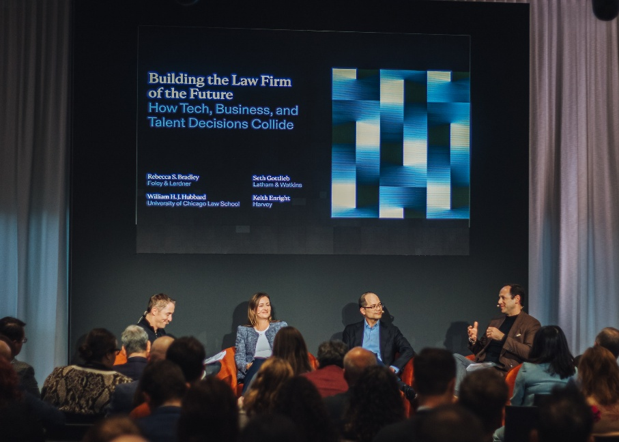
I had the opportunity to delve into what that could look like as a panelist for the Building The Law Firm of the Future: How Tech, Business, and Talent Decisions Collide program during Harvey Forum Chicago 2026. I was joined on this panel by Latham & Watkins Partner and Global Vice Chair of the Technology Industry Group Seth Gottlieb and The University of Chicago Law School Clifton R. Musser Professor of Law and Economics William H. J. Hubbard. Our conversation was moderated by Harvey Chief Strategy Officer Keith Enright. Here are a few key takeaways.
Efficiency can create more room for apprenticeship if we deliberately use the time.
AI creates something that is extraordinarily valuable in a profession where time is always at a premium: capacity. The challenge for firms is what we do with it.
If AI saves an hour on an assignment and that hour simply disappears into the next task, we have gained efficiency but may have lost a developmental opportunity. If we deliberately reinvest some of that time in feedback, client exposure, and discussion of strategy and judgment, we can make the apprenticeship experience richer.
Efficiency alone is not the goal of talent development. Learning takes time, repetition, experimentation, and sometimes struggle. It requires opportunities to decide, test your reasoning, receive feedback, and try again.
This investment can include simulated exercises and repetitions. For litigators, that might mean privilege-review exercises, mock objections, and advocacy exercises. It can include more feedback from experienced lawyers, who can explain the “why” behind the work, and earlier client exposure to help understand that context first-hand. It also requires honesty about the past: not every junior associate’s struggle in the pre-AI era built judgment. We can redirect the time saved on those tasks toward experiences that do.
AI can help build these experiences, too. The same technology that is changing the practice of law can make simulations easier to create, personalize, and repeat. It can generate a fresh set of documents with planted privilege issues, for example, or play opposing counsel or even an arbitrator in a practice argument.
The feedback itself also has to evolve.
As AI becomes part of everyday legal work, supervising lawyers increasingly need to understand not only the finished product, but also the process by which it was created. This offers another opportunity for partners and associates to have more substantive conversations about how work gets done.
When an assignment is made, the supervising lawyer may address whether AI use is appropriate or where it might add value, if there are client restrictions or expectations, and the level of verification required in addition to the expected deliverable and timing. When the work comes back, the conversation can extend to how the associate used AI, what they asked it to do, how they refined and verified the output, and if there is anything in the work they do not fully understand.
Consider a first-year associate who submits a research memo drafted with AI assistance. A supervising partner who asks “What did you ask the tool to do, and how did you check the citations?” learns far more about the associate’s judgment than one who only reads the memo. The associate also learns that verification is part of the job.
Focus on the capabilities, not the tasks.
The core capabilities lawyers need to develop — judgment, ethical decision-making, writing and communication, and understanding client objectives — have not changed. Judgment, for example, is the instinct that makes a first-year pause over a clause that looks routine, or question a case citation that seems a little too perfect. In the first few years of practice in an AI-enabled profession, one of the most important forms of judgment young lawyers will develop is knowing where AI belongs in the workflow, not simply knowing how to use it.
For a law student or junior lawyer, that distinction matters. Your value will not come from competing with a tool to see who can produce a first draft faster. It will come from understanding the problem well enough to decide what the tool should do, recognizing when its output is incomplete or wrong, and knowing how to improve it.
Judgment remains the point.
AI makes the distinctly human parts of excellent lawyering such as asking the right question, exercising skepticism, and understanding what matters to the client even more important. The time and capacity this technology creates give us a chance to teach more deliberately and to bring junior lawyers closer to strategy, clients, and judgment sooner. For law students and young lawyers looking ahead, there is good reason for optimism.