Buy, Sell, or Wait: What We Learned from Two Private Equity Sponsors, an Investment Banker, a CFO and a Lawyer
Key takeaways
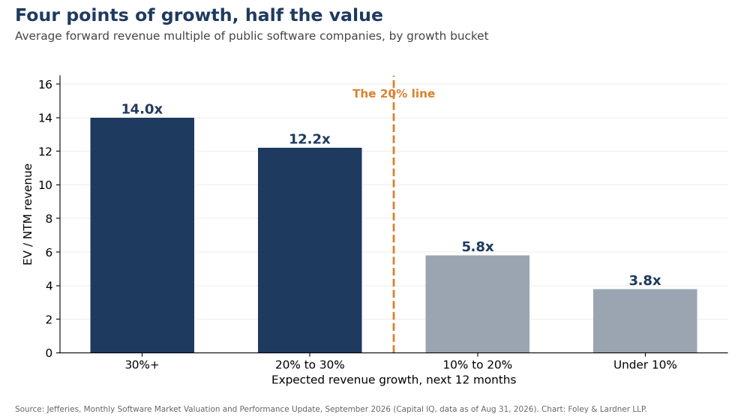
- Software valuations now turn on a growth threshold of roughly 20 percent. Companies above it command multiples about twice those of companies below it, in public and private markets alike.
- Generative AI is displacing services and headcount rather than enterprise software. Customers are combining headcount and AI budgets and holding headcount flat, which lengthens sales cycles without replacing installed applications.
- Product execution has become the first question in diligence. Historical metrics are no longer reliable predictors; investors now ask whether a product becomes more or less valuable as AI models improve.
- A company is in a process from its first conversation with an investor. A sale takes roughly a year, and the buyer’s interest lies in how the target fits its own plans, not in the seller’s valuation history.
- Price and terms are two halves of one negotiation. Structural protections are often renegotiated at exit; investors prefer a clean capital structure at a realistic price. The legal preparation that matters most, contracts, change-of-control provisions, earnout definitions and insurance, is inexpensive a year in advance and costly at signing.
Introduction
Last night, we hosted a panel for the CFO Executive Forum, an Open Future Forum community, on a question that arises at nearly every board meeting of a venture-backed software company: whether to buy, sell, or wait. The audience included private equity sponsors, venture investors, founders and finance leaders. Our panelists were Rob Bartlett, Global Head of Infrastructure and Cybersecurity Software at Jefferies; Jason Babcoke, co-founder of Sumeru Equity Partners; Harish Belur, Partner at Riverwood Capital; and Gargi Ray, Vice President of Finance at Synopsys. The CFO Executive Forum is an invitation-only community of senior executives, investors and dealmakers.
The discussion was held under the Chatham House rule. What follows is my summary, not a transcript, and should not be attributed to any panelist or firm.
Where the market stands
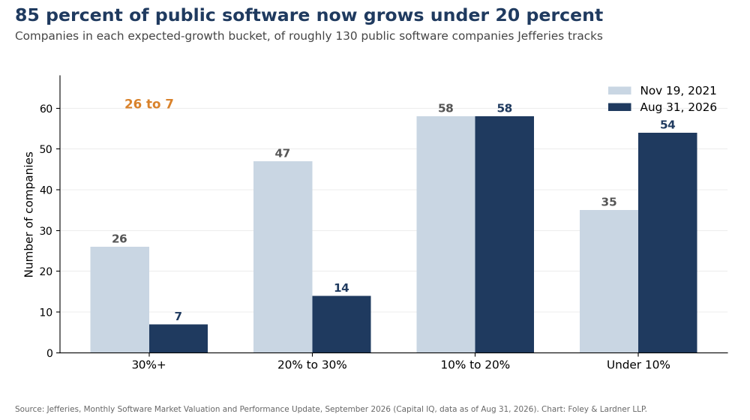
The evening’s framework came from Rob Bartlett’s (Jefferies) September software valuation update. Two observations are worth drawing out. First, the relationship between growth and valuation is not linear: public software companies growing faster than roughly 20 percent trade at multiples about twice those of slower-growing companies. Second, private transactions reflect the same divide. A company growing near 25 percent with a disciplined cash profile can still attract competitive interest; below that, the universe of buyers narrows considerably. The era in which reasonable operating metrics assured a floor price from a sponsor has ended; four times revenue may be expensive for one company and eight times reasonable for another.
The sale of Miro to Bending Spoons, announced this month, illustrates the point. A profitable company with roughly $600 million of annual recurring revenue, valued at $17.5 billion in 2022, sold at an enterprise value of about $1.36 billion. No one in the room confessed to it, but many companies are living some version of that movie. From a lawyer’s perspective, the relevant question in such a sale is not the headline multiple but the liquidation preference stack, and who is actually paid at the agreed price. This is an analysis the company should undertake before any buyer has the chance.
Generative AI and enterprise software
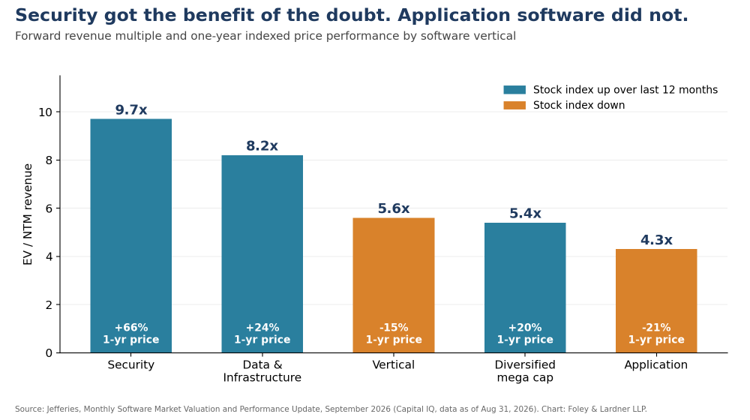
The most contrarian view of the evening was also the most reassuring for software companies. The frontier AI laboratories are not, on the evidence to date, taking revenue from enterprise software. Their revenue is coming from spending that would otherwise have gone to professional services and headcount. Companies are treating personnel costs and AI consumption as one budget line and holding headcount flat. The effect on vendors is a longer sales cycle, not a loss of installed products.
One panelist compared the moment to 1995 rather than 1999: the first consumer internet company had just gone public, and the durable business models were still to be built. The laboratories, with their consumption pricing and readily switching customers, may yet remind the market why multi-year contracts are valued, and their acquisition teams represent a new category of buyer.
Growth in the sector is reaccelerating, but unevenly, and buyers therefore begin with one question: does artificial intelligence make this company more valuable or less? For companies selling departmental software, the relevant competitor is now the general-purpose model already on every employee’s desktop, much as Microsoft Office once set the baseline for productivity software. The encouraging corollary is that the laboratories have little interest in the specialized end markets in which most software companies operate.
Product execution and the standing process
For more than a decade, a strong retention figure was adequate evidence of a good product in a good market. Investors no longer treat historical metrics as predictive. What they underwrite now is the future roadmap, the engineering organization, win-rate trends, the risk that an adjacent platform will bundle the product, the job the product performs for the customer and, above all, whether that job becomes more or less important as the models improve. Because the product acquired today will differ materially from the one eventually sold, product execution has moved to the top of the diligence agenda.
That diligence now has a legal dimension that did not exist three years ago. Buyers ask who owns code written with AI tools, whether customer agreements permit training on or reuse of customer data, and whether the company’s terms of service will withstand the scrutiny. These are contract questions, inexpensive to address a year in advance, and potentially very costly during a negotiation.
The golden nugget I expect to repeat most often to clients from what I heard in the room last night is that a company is in a process from the moment it first speaks with an investor, and remains in one as long as an investor sits on its capitalization table. A sale typically requires a year (six months of preparation and six months of process), and a serious buyer will examine every customer record. Nothing will escape the scrutiny.
Two more golden nuggets when considering how you engage with a buyer:
- First, the buyer is indifferent to the seller’s valuation history. A prior round and a preference stack are the seller’s concerns. A financial sponsor is underwriting to a target return, typically three times invested capital over five years, and will pay for that outcome if it believes management can deliver it. A strategic buyer will underwrite to a product roadmap that delivers an outcome that it can’t produce on its own (buy vs. build).
- Second, a seller should understand the buyer’s objectives before presenting its own. What the buyer underwrites, where the seller fits its roadmap and what gap the seller fills determine value, and for a strategic acquirer they matter more than sector multiples. The persuasive case is not that the company is strong, but that it is worth more to this buyer than to any other.
Finance leaders should therefore operate as though a transaction could occur at any time: review the company periodically as an outside investor would, maintain clean customer-level data and know every material contract, where diligence surprises are found. Liability caps and uncapped indemnities, discounting side letters, most-favored-customer provisions, change-of-control clauses that permit a significant customer to terminate at closing, and revenue recognition that an acquirer’s policies will restate become price adjustments, escrows or special indemnities when discovered late. Many thanks to Christina Bui and her team at Protiviti for supporting the event and the financial and accounting policies that back up a strong process. Relationships with likely strategic acquirers, developed over years, matter more than a well-prepared book sent broadly. Many thanks to Rob Bartlett and his team at Jefferies for their participation in this and other discussions.
Profitability and growth
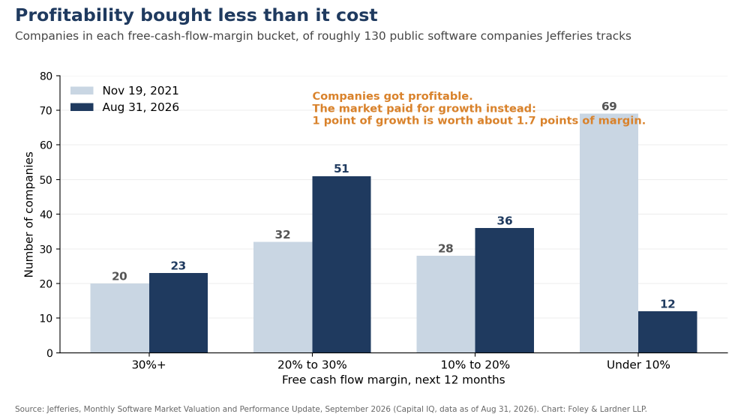
Many companies in the room spent 2023 and 2024 reducing costs to reach profitability at the direction of their boards, and the market has not rewarded that effort to the degree hoped. Even at the low point of the cycle, a point of revenue growth is worth more in valuation than a point of margin. Margin discipline was not the wrong decision, but it makes the next one harder. Buyers pay for growth they can observe rather than for a plan to restore it, and a company unable to fund four quarters of its own plan is a financing candidate, not a sale candidate.
Price and terms
Structural protections, including senior preferences, accruing dividends, earnouts and contingent value rights, are attractive when projections hold and problematic when they do not. When results fall short, management can reach an exit with little to show for years of effort, and the structure is frequently renegotiated at that point anyway. The investors on the panel preferred realistic economics at the outset with an ordinary common equity structure, even at a lower price. Where a gap must be bridged, the preferred tools were management rollover, a bifurcated price under which secondary sellers accept a discount to the primary round and, where structure is unavoidable, upside participation above a target return rather than a preference that impairs the common. The downside for common holders should be tested before signing. This phrase captured our discussion: “tell me the price, and I will tell you the terms.”
Three points from my own practice. Earnouts are litigated when their definitions are ambiguous; a durable earnout is tied to one revenue line, one measurement period and a covenant by the buyer to operate the business in the ordinary course. Representations and warranties insurance is now standard, and its underwriters conduct their own diligence; exclusions, increasingly for cyber and AI matters, return to the seller as special indemnities. And cyber insurance should be purchased before it is needed. My thanks to Preet Gill and Logan Payne of Lockton insurance for their support.
Conclusion
A transaction is not complete at closing. An acquirer should assemble a harmonized data set across combined companies before closing, behind an information barrier, so that it can jump out of the gate with a combined view of the business from the start. Integration deserves that attention. A target company’s finance leader should also recognize that leverage ends at signing; change-of-control arrangements, including double-trigger acceleration, retention for the finance team and a defined transition role, should be settled then.
As to the question in the title, the honest answer is that it depends on the company. But the panel left me with a more specific view. This is a market that rewards preparation, and most of the panelists believe conditions are improving, with growth reaccelerating, public markets reopening and a more active M&A environment likely in 2027 and 2028. Whichever course a company chooses, it should choose deliberately. Waiting is a legitimate strategy; drifting is not.
My thanks to Open Future Forum; to our co-sponsors Lockton, Robert Half and Protiviti, and Silicon Valley Bank; to Joseph George Fine Wines; and to Rob, Jason, Harish and Gargi for a candid discussion. The next session is called “Ready for Anything” on October 6 at our San Francisco office.
Charts are drawn from Jefferies’ Monthly Software Market Valuation and Performance Update, September 2026, with Capital IQ data as of August 31, 2026, and used with permission.