



Tariff-ied! – Substantial Transformation
International Trade Compliance, Four Panels at a Time
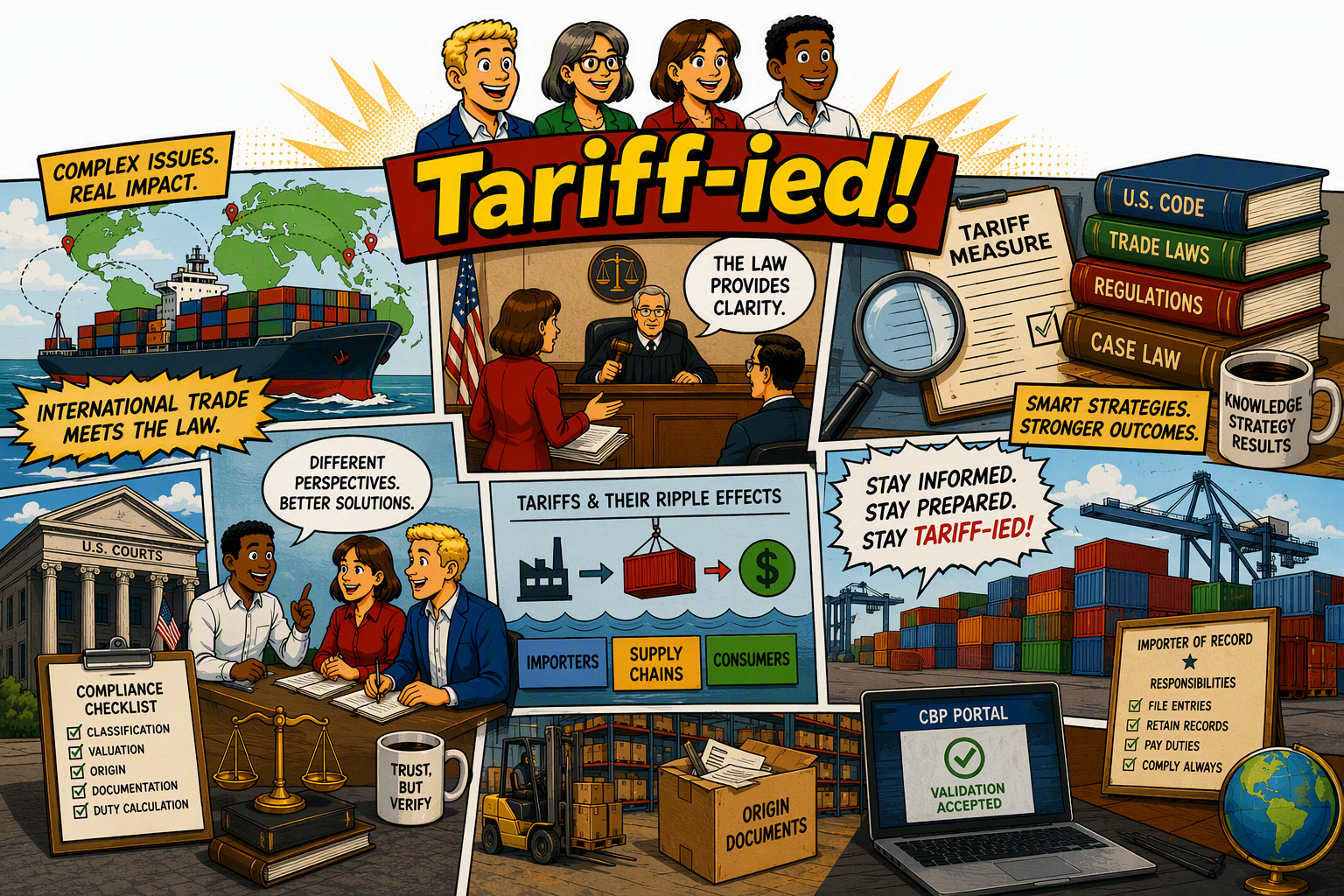

Key Takeaway
Substantial transformation rules determine when processing or manufacturing changes a product’s country of origin, generally requiring a significant change in name, character, or use compared with its inputs. Under U.S. customs law, this is a fact‑specific analysis focused on whether processing in a country meaningfully alters the product’s essential identity — simple assembly or minor finishing usually does not, while complex manufacturing that creates a new commercial article often does. Because origin status drives the application of tariffs, quotas, and trade remedies, importers should conduct robust substantial transformation analyses for key products, especially those that rely on parts and components from high‑tariff countries such as China.
This Week in International Trade
How do you substantially transform U.S. trade policy? We will soon see if the recipe starts with mid-term elections.
This week’s international trade developments include the following:
Tariff Refunds
- CAPE Phase 3 Refunds. The process for seeking refunds for finally liquidated entries is now working smoothly (for the most part), giving importers who have filed 1581(i) actions at the Court of International Trade (CIT) a route to refunds for entries that are more than eighty days from liquidation. If you would like to discuss potentially filing a refund action at the CIT, please contact the author.
Tariff Policy
- The Impact of the Mid-Term Elections on Trade Policy. Democrats’ takeover of both the House and Senate signals voter dissatisfaction with the Trump administration’s economic and tariff policies, setting up a tougher political environment for those tariffs going forward. The most likely test will start with the unpopular Canada tariffs. While Congress may push to roll back or constrain tariff authorities (e.g., the re-introduction of Schumer’s bill to repeal Section 338 and terminate forced-labor tariffs), President Trump will still retain significant unilateral tariff power unless Congress can overcome a veto. Further details are provided in our article on What Every Multinational Should Know About … The Impact of the 2026 U.S. Midterm Elections on U.S. Trade Policy.
Import Regulations & Enforcement
- New Foreign IOR Rules. Customs and Border Protection (CBP) has issued an interim final rule effective January 5, 2026, requiring foreign importers of record to either be Customs-Trade Partnership Against Terrorism (CTPAT)-validated themselves or use a CTPAT-validated customs broker in order to make entry, and it creates new Automated Commercial Environment (ACE)/entry form declarations distinguishing U.S. and foreign Importer of Records (IORs), with brokers obligated to verify and document their clients’ U.S. IOR status. The rule also tightens broker requirements (including mandatory powers of attorney), broadens CBP’s ability to impose higher Section 1592 penalties on brokers, and clarifies detailed criteria for what constitutes a U.S. versus foreign importer of record.
- ACE Errors. CBP reports that, due to an ACE issue on October 28–29, some filers received erroneous statements, including duplicate or out-of-date statements. Filers should ignore July 29–30 statements and any statements received before their scheduled print date, use ACE report REV‑104 to identify the correct statement number, reschedule statement dates if needed, and contact their CBP client representative if questions remain.
Trade Remedies
- Negative Determination in the High Purity Dissolving Pulp Antidumping and Countervailing Duty Investigations. The U.S. International Trade Commission (ITC) found that imports of high purity dissolving pulp from Brazil and Norway, though sold at less than fair value and subsidized in Brazil, are not materially injuring or threatening to injure the U.S. industry. Because of this negative determination, Commerce will not impose antidumping or countervailing duties on these imports. The Norwegian producer was represented by the Foley International Trade layers.
- Affirmative Determination in the Chromium Trioxide Antidumping and Countervailing Duty Investigations. Commerce will issue antidumping duty orders on chromium trioxide from India and Turkey and a countervailing duty order on Indian imports after the ITC determined these imports materially injure U.S. industry by being sold at less than fair value and subsidized by India. Five ITC commissioners supported the injury finding, and the full report explaining the decision will be posted by December 16, 2026.
Export Controls & Economic Sanctions Regulations & Enforcement
- OFAC Sanctions. Treasury’s Office of Foreign Assets Control (OFAC) has sanctioned eight Canada-based money services businesses for facilitating digital asset transactions for Iran, including sanctioned Iranian exchanges and Islamic Revolutionary Guard Corps (IRGC)-linked wallets, and for laundering drug proceeds, some in coordination with narcotrafficker Ryan Wedding. Under Executive Order 13902, all U.S.-linked property of these firms is now blocked, U.S. persons are broadly prohibited from dealing with them, and both U.S. and non-U.S. persons face potential civil or criminal penalties for sanctions violations or evasion.
- Export Controls and Sanctions Enforcement Action. The Department of Justice (DOJ) and OFAC resolved sanctions and export control violations by a U.S. company that, via its Russia-based subsidiary, sold networking equipment and services over four years to a Russian weapons manufacturer owned by an SDN-listed entity, concealing the buyer and causing false export filings. Under DOJ’s 2026 Corporate Enforcement and Voluntary Self-Disclosure Policy, the company received a non-prosecution agreement but must pay nearly $1 million in criminal penalties, plus a $1.53 million OFAC settlement, after cooperating and remediating but disclosing only under imminent media exposure.
Like To Learn More or Get in Touch?
Join our mailing list to receive future emails and practical international regulatory compliance tips, including our weekly What Every Multinational Should Know and Tariff-ied! This Week in International Trade articles. And if you have any international trade questions, then please feel free to email [email protected].
The Foley International Trade & National Security Practice
The Foley International Trade & National Security Team advises companies across the full spectrum of international trade issues, including tariffs and Customs compliance, supply chain integrity, trade remedies (antidumping and countervailing duties), export controls, economic sanctions, and CFIUS national security reviews. Our Tariff & International Trade Resources blog regularly publishes practical guidance on all international trade topics and compiles it by topic area.