




The Growth Equity Docket Vol. 1 No. 5 – Cash, Growth and the New Deal Terms

Friends,
Limited partners want cash, not marks. Private equity holds roughly 13,500 American companies, a third of them for more than five years, and 2021 buyout funds have returned about 14 cents on the dollar. That pressure is now writing the deal terms: continuation funds, minority recaps and sales to strategics. At the same time, nearly half of public software is accelerating again, double the share in late 2023, and the public market is paying a steep premium for it. Both trends end up in the documents. And this morning’s inflation report came in hot, which puts an October rate hike back on the table.
The Cash Problem
A fund owes its investors two things: value on paper and cash in hand. For four years, investors have received mostly paper. Distributions have run below 15 percent of net asset value four years running, by Bain’s count. Buyout funds of the 2021 vintage have distributed 0.14 times paid-in capital; 2021 venture funds, 0.05 times, the weakest start since 1997 by PitchBook’s data. An LP that has not been paid back cannot recommit, which is why fundraising lags even as deal activity recovers.
Sponsors are generating liquidity through four routes, each with its own legal pressure points:
🔹 Continuation funds. The sponsor sits on both sides of the trade. The LPAC consent, the fairness opinion and the election offered to existing investors carry the weight. Fewer than 5 percent of LPs are rolling, per research PitchBook cited Friday, so the price has to hold up to a buyer that is not the sponsor. Secondaries reached a record $121 billion in the first half.
🔹 Minority sales and structured recaps. Selling 30 percent to a growth investor returns cash while keeping control, but the new investor will want consent rights, a liquidation preference and a path to exit. Those terms bind the next buyer.
🔹 Dividend recaps. These are harder with the 10-year Treasury above 5 percent, and the board must be satisfied on solvency before it declares the dividend.
🔹 Sales to strategics. TA sold Rocscience to Hexagon on Friday, three years after investing.
For portfolio company management, a continuation fund can look like a non-event: the same sponsor, the same board. It is not. The transaction can trigger change-of-control provisions, reset vesting, convert rollover equity and amend the management equity plan. Management should have its own counsel, separate from the fund’s.
For founders taking growth capital, ask about the fund’s vintage and its distributions to date. The fund’s timeline becomes your timeline, and it will appear in the drag-along and redemption provisions.
Thank you to Jersey Finance for Monday’s LP/GP evening at Foley San Francisco.
Software Is Accelerating Again, at the Top
My friend Rob Bartlett and his team at Jefferies published a study this week on revenue acceleration in public software. The AI infrastructure build-out is now visible in software revenue, and the market is paying a premium for it.
🔹 Breadth. In December 2023, 22 percent of public software companies were growing faster than the prior year. Today 46 percent are. The 2021 peak was 68 percent, and median growth remains about half what it was then.
🔹 Concentration. Twelve of the 14 companies above $200 billion in market value are accelerating, led by the sellers of AI capacity: Microsoft, Google, Amazon, Oracle and Broadcom. Above $50 billion, 77 percent are accelerating. Below $5 billion, 31 percent. In 2021 the acceleration was broad. This time it is concentrated at the top.
🔹 The premium. Among companies growing over 20 percent, accelerators trade at 11.2 times next year’s revenue and decelerators at 4.6 times, a gap of more than six turns. Below 10 percent growth, the gap is about 0.2 turns.
🔹 Sectors. Security and data infrastructure are being rewarded most. Accelerating security names are up 50 percent over the year. Application and vertical software are down even where growth is improving.
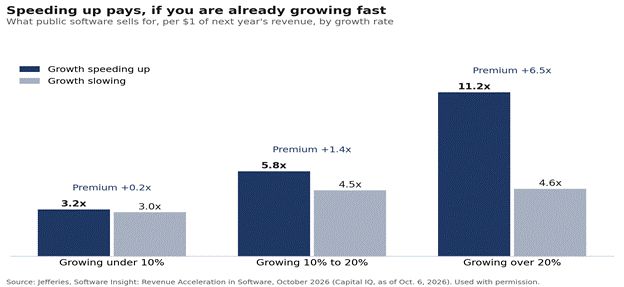
For deal lawyers, the implication is straightforward. When acceleration is worth six turns, the trajectory of revenue becomes a negotiated term. Expect buyers to diligence the last four quarters line by line, to challenge how ARR and net retention are defined, and to bridge valuation gaps with earnouts tied to growth rather than a higher headline price. Sellers should define their metrics in the disclosure schedules, tie them to the audited financials and limit the representations to what the data will support. Most private mid-market software sits in the part of the market where acceleration is rare. A company that can document it has leverage. One that cannot will be valued on cash flow.
The Legal Bench: New General Counsel
Sponsors and late-stage boards are hiring general counsel earlier and from bigger seats. The past month brought several moves into sponsor-backed and venture-backed companies:
🔹 ID.me named Susannah Stroud Wright Chief Legal Officer on September 28, after eight years as CLO of Credit Karma.
🔹 Proofpoint (Thoma Bravo) named Brian Levey Chief Legal Officer in September. He was chief business affairs and legal officer at Upwork.
🔹 Sedgwick (Carlyle majority-owned) named Courtney Welton Global Chief Legal Officer on September 22. She was general counsel and chief ethics, privacy and compliance officer at Allstate.
🔹 Nscale, the AI cloud company preparing a U.S. listing, named Adam Rosman Chief Legal Officer effective October 1. He was chief legal and administrative officer at Fiserv.
🔹 Reliable Robotics hired its first general counsel, Russ Elmer, on October 9. He was general counsel of ServiceNow for about eight years.
🔹 Houlihan Lokey, the investment bank, named Prabha Sipi Bhandari Chief Legal Officer, succeeding Christopher Crain, general counsel since 2004.
The pattern: public-company general counsel are moving into private, sponsor-backed companies, and a first senior legal hire usually signals a listing or a sale within two years. BarkerGilmore’s 2026 survey of more than 270 portfolio-company general counsel puts median base salary at $300,000 below $500 million in revenue and $450,000 above $5 billion, with long-term equity a large share of total pay. The terms that matter are rarely the salary. They are the equity plan, treatment on a change of control, indemnification and D&O coverage, and a reporting line to the board as well as the CEO. When the sponsor and the company share counsel, privilege needs particular care.
If you have a move to announce, send it to me and I will include it in a future issue.
Venture’s Record Year Is an AI Year
The third-quarter PitchBook-NVCA Venture Monitor shows $516 billion invested through September, 44 percent above the full-year record set in 2021, with 83 percent going to AI. The market underneath is narrow: 81 first-time funds closed, a decade low at this pace, and Airtable sold at close to a 90 percent discount to its last private price. Companies outside AI that raised at 2021 valuations will need a buyer or a structured round, and the terms of that round will be dominated by the preferences stacked above common. My partners Andre Thiollier and Natasha Allen break down the quarter.
The Growth Tape
Technology. Ithaca Holdings agreed Tuesday to take Bumble private for about $1.3 billion, $6.05 a share in cash, a 138 percent premium. Holders of a majority of the voting power approved the deal by written consent, so there will be no stockholder meeting. Minority holders will receive an information statement and keep their appraisal rights. KKR is acquiring Gen II, the fund administrator, from Hg and General Atlantic at a $5.1 billion valuation.
Healthcare. Clayton, Dubilier & Rice and McKesson agreed to take Option Care Health private for about $5.8 billion, a 37 percent premium. McKesson will hold about 49 percent with a path to the rest. A sponsor-strategic consortium raises the governance questions that matter most here: consent rights, the call mechanics and what happens if the partners disagree. STERIS is acquiring Xodus Medical for $2.1 billion.
The Loan Desk
The 10-year Treasury closed Tuesday at 5.21 percent, after touching about 5.31 last Wednesday. The 30-year ended at 5.56. High-yield spreads widened to about 3.15 percentage points. Credit remains available, at a price.
September CPI came in above forecast. Prices rose 0.6 percent for the month and 3.7 percent from a year ago, up from 3.4 percent in August, driven by a 9.1 percent jump in gasoline. Core inflation, excluding food and energy, rose 0.3 percent for the month and 2.6 percent for the year, against 2.4 percent in August. The 10-year moved back toward 5.29 percent on the release. Futures now price an October 28 hike at about 45 percent, up from about 22 percent before the report, and the September minutes already showed most participants expecting one more increase this year. Deal teams should continue to underwrite floating-rate debt with another quarter point in it, and should not model a cut before 2028. Ticking fees, outside dates and financing conditions remain live points in the negotiation.
In the Courts
🔹 Anderson v. Intel, argued October 6. Observers expect the Supreme Court to require plaintiffs to plead a meaningful benchmark before challenging a 401(k) investment option as imprudent. That would put a private equity option in a retirement plan up against a comparable alternative rather than an index fund, which helps plan sponsors considering private markets. The Labor Department’s proposed rule on alternatives in 401(k) plans is still not final.
From My Desk
🔹 What Your Software Company Is Worth Now. The 20 percent growth line, in Jefferies’ numbers.
🔹 Ready for Anything: Open for Whom? Our October 6 panel on IPOs and SPACs.
🔹 SPAC 4.1: Plenty of SPACs, Plenty of Targets. So Who Is Paying for the Deal?, with Eric Chow and Alexandre Camargo Turqueto. The constraint is cash at closing, and six structures that get deals there.
🔹 Prefer this in your inbox? Subscribe on Substack.
On the Calendar
🗓 Investors on the Bay, a Fall Mixer, Friday, October 23, San Francisco. Register.
🗓 One Way Ventures Summit, Wednesday, October 28, San Francisco. Register.
🗓 General Counsel Executive Forum, Private Lunch, Friday, October 30, San Francisco. In-house counsel only. Request a seat.
🗓 IPO Readiness, Wednesday, November 18, San Francisco, with SVB, Protiviti and Heffernan. Reply for a seat.
🗓 2027 Outlook, Friday, December 11. Reply for a seat.
Closing Argument
🔹 Sponsors: the next fund depends on distributions from the last one. Build the exit into the deal before the fundraise.
🔹 Management teams: if a continuation fund is coming, review your equity terms and retain your own counsel.
🔹 Software sellers: if growth is accelerating, document it quarter by quarter and define the metrics yourself. Above 20 percent growth, it is worth six turns.
🔹 Boards: hire the general counsel before the banker. The legal work for an exit starts two years out.
A question for you. Are your investors asking for cash or for patience? Write back; I read every reply.
Paper is a promise. Cash is the proof. The companies that are ready get to choose.
— Louis
#TheGrowthEquityDocket #AskASiliconValleyLawyer #FoleyIgnite #garage2global #growthequity #privateequity #secondaries #continuationfunds #software #generalcounsel #techlaw
Standard disclosures: opinions my own, not my firm’s. Not legal advice. Attorney advertising. Prior results do not guarantee future performance. This newsletter is built the way I believe modern legal work should be done. I use AI for productivity and efficiency in research and drafting. The ideas are mine, the voice is mine, the edits are mine, I check the facts, and I own every word. Foley & Lardner LLP represents sponsors, lenders and companies, some of which may be active in the matters discussed. Software data from Jefferies’ Software Insight: Revenue Acceleration in Software, October 2026, compiled from company filings and Capital IQ as of Oct. 6, 2026, used with permission. Executive appointments from company announcements; compensation data from BarkerGilmore’s 2026 Private Equity Portfolio Company General Counsel Compensation Report. Fund and market data from PitchBook, the PitchBook-NVCA Venture Monitor (Q3 2026), Bain & Company’s Global Private Equity Report 2026 and company announcements. Rate data from the U.S. Treasury and the Federal Reserve Bank of St. Louis; inflation data from the Bureau of Labor Statistics release of Oct. 14, 2026, and rate-futures odds as reported that morning.