The Growth Docket

Control capital for growth. Where venture ends and buyouts begin.
Growth equity sits between venture capital and the buyout. It is a large check, often for control, that does three things at once. It funds growth. It pays cash to founders and early investors. And it builds the scale to sell the company later. It uses little or no debt. That matters this year, because debt is expensive and lenders are picky.
This newsletter covers that market every Wednesday. Same order every week. Six minutes to read. Three sectors: technology, life sciences and healthcare, and the energy that powers data centers.
This week: banks have billions of buyout loans to sell. The DOJ announced a proposed $250 million settlement related to alleged HSR filing violations. Fed raises interest rates for the first time since 2023.
The Big Issue
Every growth deal in the market is being priced against three facts.
Investors are not getting cash back. The funds raised from 2019 to 2023 were the largest ever. They have returned very little cash. The industry calls this DPI: for every dollar an investor put in, how much has come back. For those funds, it is under 35 cents. On paper, the returns look fine. Investors have stopped reading paper. Growth funds took 22% of all money raised last year, because they use less debt and can point to real sales to real buyers. That edge lasts as long as the cash keeps coming.
Sales are slowing. Software revenue growth has slowed for six straight quarters. The sector is healthy, but there are fewer natural buyers. A growth round today is priced on 2027 sales. The people forecasting 2027 have been wrong twice.
The SaaSpocalypse. On February 3, Anthropic released AI tools that do legal review, compliance and sales prep. That day, the stock market erased about $285 billion from software, legal-tech and data companies. Thoma Bravo said in June that The SaaSpocalypse is over. The market has not agreed yet. Software is not dead. But charging per user for a workflow tool is now negotiable. Buyers still pay for three things: data no one else has, regulatory moats, and software that sits inside a transaction. Every software deal now starts with one question. What happens to revenue when the customer’s AI can do this job?
What this means in the paperwork. Investors are writing in protections nobody asked for in 2021. Preferred stock that gets its money back first, and then shares the upside. The right to make the company buy the stock back after a set number of years. Price adjustments tied to sales targets, not to an IPO. Board control that survives a down round. Founders are pushing back and winning some of these fights. They should, when the company can grow into its price. Most can. The ones that cannot are the ones a growth investor should skip.
The Scoreboard
One chart runs every issue, refreshed each quarter.
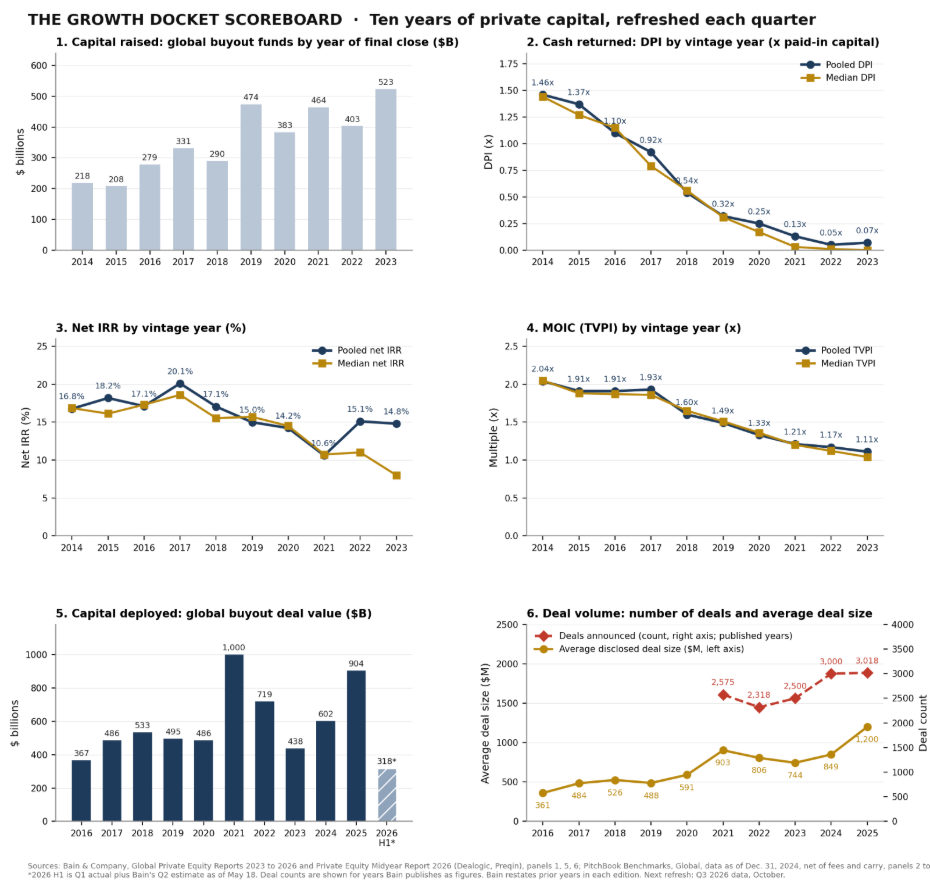
What it shows. The biggest funds ever raised have returned the least cash. That is already in fund agreements: carry that pays only after cash comes back, limits on reinvesting proceeds, and investor consent before a fund sells a company to itself. The number of deals has been flat for two years. Total value swings with a few giant deals. Exits are rising in number and falling in value, which means mid-sized companies are finally selling. Expect earnout structures to bridge price gaps, and more insurance to cover the promises a seller makes about the business. Growth equity is a small slice by dollars, a growing slice by deal count, and it beat buyouts last year without borrowing. Buyouts have moved toward growth’s model: a full turn less debt, equity above half the price. The difference is where the investor’s protection lives. In a buyout, it is the loan agreement. In growth equity, it is the company’s charter and the shareholder agreement. The investor controls those.
The Growth Tape
Technology. Summit Partners led a growth investment of more than $1 billion in Keyfactor, a security company. Insight and Sixth Street stayed in. That is the template: a big check for control, existing investors kept, no debt. The terms that matter never make the press release. Who controls the board after the round? Does the new money get paid back before the last round, or alongside it? When founders sold shares, did they make promises about the business, or just hand over the stock? Investors should insist on the promises. Founders should cap them.
Thoma Bravo’s $4 billion-plus purchase of Accelerant, an insurance data company, is a lesson in structure. A 49% premium, approved by a committee of independent directors. The founders and their prior investor, Altamont, kept their shares in the new deal instead of cashing out. And a ticking fee: if insurance regulators are slow, the buyer pays 6% a year on the price until closing. Those three terms are how a founder-led company gets taken private.
Anthropic walked away from a $6 billion purchase of Decart. In AI deals, the buyer’s mind can change in a quarter. Draft the deal protections as if it will.
Life sciences and healthcare. KKR’s $5.9 billion purchase of Integer carried a slow August. WindRose closed a $2.6 billion healthcare fund. The problem for every healthcare deal is now the states. More than a dozen require notice or approval for deals well below the federal threshold. Several name private equity directly. The state attorney general will read the management services agreement, the contract that lets a sponsor run the business side of a medical practice without owning it. Build three to five months into the timeline. Write that agreement as if it will be exhibit A. It will be.
Energy and data centers. Energy deal value is up sharply this year. The reason is electricity for data centers. A data center with a long lease to a big cloud company and a confirmed grid connection can borrow almost like a utility. One waiting in line for the grid cannot. Goldman Sachs Alternatives sold Boyd’s thermal business, which cools data centers, to Eaton for $9.5 billion. That is what a strategic buyer pays for scale in the AI supply chain. The due diligence is legal before it is technical: the tenant’s credit, whether the lease can be transferred, the grid connection deadlines, and who pays when the utility cuts power. Underwrite the contracts. The story is free.
Funds and People
- Goldman Sachs Alternatives, $11.7 billion. Announced yesterday: $9.6 billion for its ninth flagship buyout fund, plus an Asia fund and co-investment vehicles. Goldman and its own employees put in a meaningful share. A firm that just sold Boyd for $9.5 billion had cash to show investors. That is not a coincidence.
- Anton Levy, Layer Global. The former General Atlantic co-president raised $1.1 billion at first close for a concentrated growth fund focused on AI. It is the year’s most senior growth spinout. A concentrated fund raises fund-agreement questions: how much can go into one company, what happens if a key partner leaves, and how proceeds may be reinvested.
- Insight Partners is deploying its $12.5 billion Fund XIII with a higher bar than 2021, which is not a high bar. McKinsey reports growth fundraising rose 16% in North America last year while nearly every other category fell. WTW bought FlowStone, and MetLife closed $1.2 billion by selling stakes from its own balance sheet into a new fund. When insurers and advisers buy their way into secondaries, they are betting the cash-back problem will last.
- Bay Area. California companies have raised about $366 billion of venture capital this year, more than the other forty-nine states combined. New fund, new office, new partner or senior hire.
Exits
Corporate buyers are the buyers of choice. Eaton bought Boyd. CD&R took Sealed Air private for $10.3 billion. The IPO window is open for the largest companies, where Medline listed at $7.2 billion, and closed for the rest. Continuation vehicles, where a sponsor sells a company from an old fund to a new fund it also runs, remain under 10% of exit value. Investors will accept about one a year from a given firm.
The Loan Desk
J.P. Morgan says banks plan to sell about billions of buyout loans before year end, the most since 2007. Spreads, the interest a borrower pays above the base rate, are the tightest in twenty years. Most of last year’s loan volume was existing borrowers refinancing. New supply changes that. The deals lenders want will get flexible loan terms. Everyone else gets strict ones, written by lenders who remember the Serta case, where a borrower and some lenders cut a side deal that left the others behind. For a growth investor, the loan desk sets the exit price. Whoever buys a portfolio company in 2027 will finance it at whatever rate this wave sets.
On rates. The case for a hike came together in ten days. August payrolls came in at 162,000, five times the recent average. Producer prices are up 5.4%. Consumer prices are up 3.4%, with core prices up 0.3% in a month. Oil above $100 has not fully shown up yet. The futures market is pricing in a high probability of a quarter-point increase. That would take the Fed’s range to 3.75% to 4.00%. Markets appear to have largely priced in the decision itself. What matters now is the Fed’s forecast of its own path. In June, nine officials expected at least one hike this year and eight expected none. Where those forecasts land today will help determine whether this is a single move or the start of several. Either way, the interest-rate assumption in many deal models built earlier this year may need updating. Fix it before the lender does.
In the Courts
- United States v. KKR, settled August 26. KKR agreed to pay $250 million, twenty times the previous record, for merger filings that left out or altered internal documents on at least sixteen deals, and for two deals it never filed. KKR disputes the government’s account. Its outside law firms will pay the penalty, a sentence that will be read aloud at every law firm partners’ meeting this fall. The lesson is simple. When a company files a merger notice with the government, it must attach the internal decks that analyze the deal. Those decks are evidence. Editing them is now a nine-figure risk. Any firm that does more than a few deals a year should audit its filing process this month.
- Anderson v. Intel. Argument is set for Tuesday, October 6, the second day of the Supreme Court’s new term. The question: must employees who sue over private equity in their 401(k) plans first show a comparable investment that did better? The Labor Department is on Intel’s side and will share argument time. It has also proposed a rule giving plan sponsors wide latitude to include private equity. Together, the case and the rule will help determine whether growth and buyout funds gain broader access to retirement savings. That access requires a product with daily pricing, no capital calls, real liquidity and independent valuation. That is a legal build before it is a sales pitch.
- Rutledge v. Clearway Energy, Delaware Supreme Court, February 27. Delaware upheld its 2025 law protecting deals between a company and its controlling shareholder. The deal is protected if a committee of independent directors approves it, or if a majority of the other shareholders vote for it. Taking the company private needs both. For a growth investor with a control stake in a public company, this is the most useful court decision in a decade. Set up the independent committee before the next deal, not after.
- Chamber of Commerce v. FTC. The FTC’s expanded merger filing form was struck down. Filers are back on the old form. California’s own filing law starts January 1, 2027, and requires a copy of every federal merger filing within one business day.
Carry Watch
No change in the United States. Changed in the United Kingdom. Carried interest is the share of profits fund managers earn. In the US it is still taxed as capital gains, and no bill to change that has a path before the midterm elections. In the UK, carry has been taxed as income since April 6, at an effective rate near 34% for funds that hold investments long enough to qualify. Fund design in London now turns on holding period. This line runs every week and changes only when the law does.
On the Calendar
Reply for a seat at any of these.
- CFO Event, Tuesday 9/22, Foley Silicon Valley, an evening for CFOs and senior finance leaders on what is actually happening in M&A right now.
- Hard Things, Monday 9/28, Foley Silicon Valley, an evening on robotics and physical AI with guest speaker, Chris Yeh.
- SF Tech Week – Capital Markets Event, Tuesday 10/6, Foley San Francisco, for any growth-stage company weighing a listing, a sale or a sponsor recap.
- LP/GP Event with Jersey Finance, Foley San Francisco, Monday 10/12.
- One Way Ventures Summit in San Francisco, Wednesday 10/28.
- GC Lunch in San Francisco, Friday 10/30.
Closing Argument
- Growth investors with control: Delaware’s safe harbor works. Set up the independent committee now.
- Serial acquirers: audit the merger filing process this month. Your internal decks are evidence.
- Healthcare platforms: the states set the closing calendar. Write the management agreement for the attorney general, because that is who will read it.
- Founders weighing a growth round against a sale: the loan market is setting your buyer’s price for 2027. A growth round keeps the timing in your hands and the terms in your lawyer’s.
- Fund managers raising: lead with cash returned. If there is none, lead with the sale that will produce some.
Apollo’s Scott Kleinman told the Paris conference last week that the easy gains are gone and value now has to be built through earnings. Growth equity never had another way. The capital is available. The law is clearer than it was in January. The sponsors who raise in 2027 will be the ones who sold something in 2026.
Thought Leadership
- Where We Are on Software M&A – Read More. Software is healthy, but growth is slowing. It is getting easier to tell which companies will be buyers and which will be sold.
- Ready for Anything: Takeaways From a Panel on Going Public – Read More. Is the IPO window open? Yes. Are sponsor-backed companies ready to use it? Not yet.
- Aging Assets and the Patience Test for Private Equity – Read More. Holding a company too long creates legal duties before it creates bad returns.
Standard disclosures: opinions my own, not my firm’s. Not legal advice. Attorney advertising. Prior results do not guarantee a similar outcome. Foley & Lardner LLP represents sponsors, lenders and companies, some of which may be active in the matters discussed.